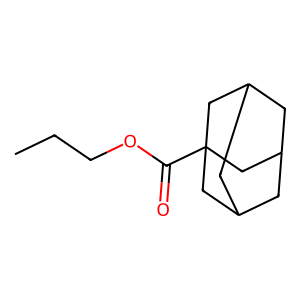
Propyl adamantane-1-carboxylate
Names and Identifiers of Propyl adamantane-1-carboxylate
CAS Number |
24556-15-8 |
|---|---|
IUPAC Name |
propyl adamantane-1-carboxylate |
InChI |
InChI=1S/C14H22O2/c1-2-3-16-13(15)14-7-10-4-11(8-14)6-12(5-10)9-14/h10-12H,2-9H2,1H3 |
InChIKey |
LVGMTYKQVATOOP-UHFFFAOYSA-N |
Canonical SMILES |
CCCOC(=O)C12CC3CC(C1)CC(C3)C2 |
Physical and chemical properties of Propyl adamantane-1-carboxylate
Boiling Point |
277.1±8.0 °C at 760 mmHg |
|---|---|
Density |
1.1±0.1 g/cm3 |
Exact Mass |
222.161987 |
Flash Point |
120.8±6.0 °C |
Index of Refraction |
1.521 |
LogP |
4.12 |
Molecular Formula |
C14H22O2 |
Molecular Weight |
222.323 |
PSA |
26.30000 |
Storage condition |
2-8°C |
Vapour Pressure |
0.0±0.6 mmHg at 25°C |
Applications of Propyl adamantane-1-carboxylate
Propyl adamantane-1-carboxylate has diverse applications across several fields:
- Chemistry: It serves as a building block for synthesizing more complex organic molecules.
- Biology: The compound is utilized in biological studies, particularly in drug development.
- Medicine: Its derivatives show promise in treating various diseases, including viral infections and neurological disorders.
- Industry: It is used in producing advanced materials such as polymers and nanomaterials due to its unique structural properties.
Interaction Studies of Propyl adamantane-1-carboxylate
The interaction studies of propyl adamantane-1-carboxylate focus on its biological mechanisms and pharmacological effects. The compound's ability to modulate biological processes through interactions with specific molecular targets makes it a subject of interest in drug discovery research. Understanding these interactions is crucial for developing effective therapeutic agents based on this compound.
Biological Activity of Propyl adamantane-1-carboxylate
Research indicates that propyl adamantane-1-carboxylate and its derivatives may exhibit significant biological activities. The compound's structure allows it to interact with various biological targets, potentially influencing enzymatic pathways and receptor interactions. Notably, derivatives of this compound have been investigated for their antiviral properties, particularly in the context of treating viral infections and neurological disorders. The adamantane moiety is known for enhancing the stability and bioavailability of pharmaceutical compounds.
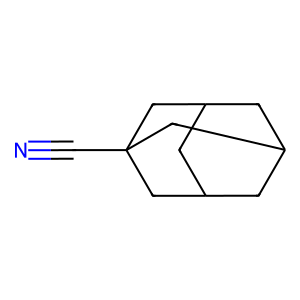 Cas:23074-42-2
