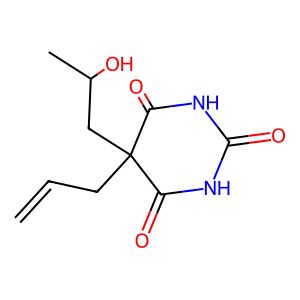
Proxibarbal
CAS No.:
2537-29-3
M. Wt:
226.22900
M. Fa:
C10H14N2O4
InChI Key:
VNLMRPAWAMPLNZ-UHFFFAOYSA-N
Names and Identifiers of Proxibarbal
CAS Number |
2537-29-3 |
|---|---|
EC Number |
219-803-4 |
IUPAC Name |
5-(2-hydroxypropyl)-5-prop-2-enyl-1,3-diazinane-2,4,6-trione |
InChI |
InChI=1S/C10H14N2O4/c1-3-4-10(5-6(2)13)7(14)11-9(16)12-8(10)15/h3,6,13H,1,4-5H2,2H3,(H2,11,12,14,15,16) |
InChIKey |
VNLMRPAWAMPLNZ-UHFFFAOYSA-N |
Canonical SMILES |
CC(CC1(C(=O)NC(=O)NC1=O)CC=C)O |
UNII |
F97OMS297F |
Physical and chemical properties of Proxibarbal
Acidity coefficient |
7.74±0.10(Predicted) |
|---|---|
Density |
1.206g/cm3 |
Exact Mass |
226.09500 |
Index of Refraction |
1.493 |
LogP |
0.23760 |
Melting Point |
157-158°; mp 166.5-168.5° from acetone + chloroform (Smissman) |
Molecular Formula |
C10H14N2O4 |
Molecular Weight |
226.22900 |
PSA |
102.48000 |
Interaction Studies of Proxibarbal
Interaction studies indicate that Proxibarbal can enhance the effects of other central nervous system depressants, including alcohol and benzyl alcohol. This raises concerns about potential synergistic effects that could lead to increased sedation or other adverse reactions when used concurrently with these substances.
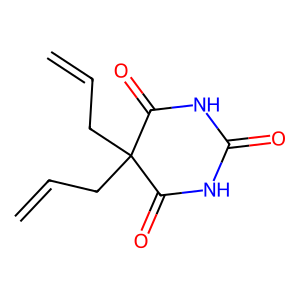 Cas:52-43-7

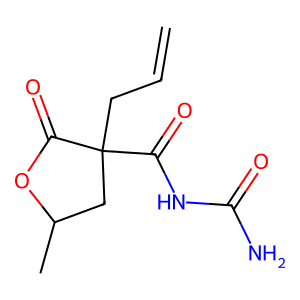 Cas:3258-51-3