
Pyrrole-2-carboxaldehyde
Names and Identifiers of Pyrrole-2-carboxaldehyde
CAS Number |
1003-29-8 |
|---|---|
EC Number |
213-705-5 |
MDL Number |
MFCD00005217 |
IUPAC Name |
1H-pyrrole-2-carbaldehyde |
InChI |
InChI=1S/C5H5NO/c7-4-5-2-1-3-6-5/h1-4,6H |
InChIKey |
ZSKGQVFRTSEPJT-UHFFFAOYSA-N |
Canonical SMILES |
C1=CNC(=C1)C=O |
UNII |
068TSM6S6P |
UNSPSC Code |
12352100 |
Physical and chemical properties of Pyrrole-2-carboxaldehyde
Acidity coefficient |
15.20±0.50(Predicted) |
|---|---|
Boiling Point |
216.00 to 218.00 °C. @ 760.00 mm Hg |
BRN |
105745 |
Density |
1.2±0.1 g/cm3 |
Exact Mass |
95.037117 |
Flash Point |
106.7±0.0 °C |
Index of Refraction |
1.607 |
LogP |
0.64 |
Melting Point |
50 - 51 °C |
Molecular Formula |
C5H5NO |
Molecular Weight |
95.099 |
PSA |
32.86000 |
Sensitivity |
Air Sensitive |
Solubility |
3.43e+004 mg/L @ 25 °C (est) |
Storage condition |
2-8°C |
Vapour Pressure |
0.32 [mmHg] |
Water Solubility |
Soluble in chloroform, dimethyl sulfoxide and methanol. Insoluble in water. |
Safety Information of Pyrrole-2-carboxaldehyde

Applications of Pyrrole-2-carboxaldehyde
1H-Pyrrole-2-carbaldehyde finds applications in several fields:
- Pharmaceuticals: It serves as an intermediate in the synthesis of various bioactive compounds and pharmaceuticals.
- Agriculture: Its derivatives may be used as agrochemicals or plant growth regulators due to their biological activity.
- Food Industry: As a flavor compound, it contributes to the aroma profile of certain foods and beverages .
Interaction Studies of Pyrrole-2-carboxaldehyde
Studies on the interactions of 1H-Pyrrole-2-carbaldehyde with biological systems suggest its potential role in modulating biochemical pathways. Its interactions with proteins and enzymes are being investigated for therapeutic applications, particularly in cancer treatment . Furthermore, its presence in various foods raises questions about its metabolic effects and health implications.
Biological Activity of Pyrrole-2-carboxaldehyde
Research indicates that 1H-Pyrrole-2-carbaldehyde exhibits various biological activities. It has been identified as a potential biomarker in food consumption, particularly in beer and certain fruits like blackberries and asparagus . Additionally, it has shown antioxidant properties and potential cytotoxic effects against certain cancer cell lines, suggesting its utility in drug development .
Physical sample testing spectrum (NMR) of Pyrrole-2-carboxaldehyde

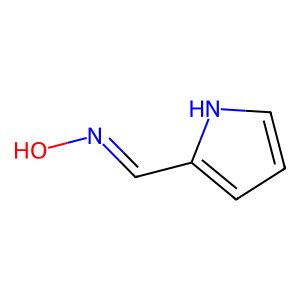 Cas:32597-34-5

 Cas:74-86-2

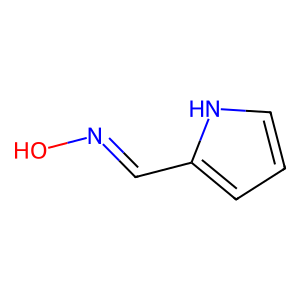 Cas:960622-17-7