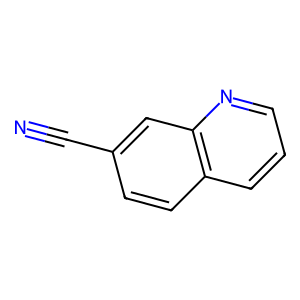
Quinoline-7-carbonitrile
CAS No.:
67360-38-7
M. Wt:
154.168
M. Fa:
C10H6N2
InChI Key:
OZMHIFNNCZPJFS-UHFFFAOYSA-N
Appearance:
Yellow Solid
Names and Identifiers of Quinoline-7-carbonitrile
CAS Number |
67360-38-7 |
|---|---|
MDL Number |
MFCD12028057 |
IUPAC Name |
quinoline-7-carbonitrile |
InChI |
InChI=1S/C10H6N2/c11-7-8-3-4-9-2-1-5-12-10(9)6-8/h1-6H |
InChIKey |
OZMHIFNNCZPJFS-UHFFFAOYSA-N |
Canonical SMILES |
C1=CC2=C(C=C(C=C2)C#N)N=C1 |
UNSPSC Code |
12352100 |
Physical and chemical properties of Quinoline-7-carbonitrile
Acidity coefficient |
1.81±0.14(Predicted) |
|---|---|
Boiling Point |
323.7±15.0 °C at 760 mmHg |
Density |
1.2±0.1 g/cm3 |
Exact Mass |
154.053101 |
Flash Point |
115.5±5.6 °C |
Index of Refraction |
1.654 |
LogP |
1.66 |
Melting Point |
104 °C |
Molecular Formula |
C10H6N2 |
Molecular Weight |
154.168 |
PSA |
36.68000 |
Vapour Pressure |
0.0±0.7 mmHg at 25°C |
Safety Information of Quinoline-7-carbonitrile

Applications of Quinoline-7-carbonitrile
Quinoline-7-carbonitrile finds applications in various fields:
- Medicinal Chemistry: It is a building block for synthesizing new pharmacologically active compounds.
- Corrosion Inhibition: Its derivatives have been studied as corrosion inhibitors in the oil and gas industry due to their ability to form protective layers on metal surfaces.
- Fluorescent Probes: Certain derivatives exhibit fluorescence properties suitable for biological and chemical sensing applications.
Interaction Studies of Quinoline-7-carbonitrile
Research on quinoline-7-carbonitrile has included interaction studies focusing on its binding affinities with various biological targets. These studies often involve structure-activity relationship analyses, revealing how modifications to the compound influence its biological efficacy. For example, some derivatives have shown promising results as inhibitors of specific enzymes involved in cancer progression or bacterial survival.
Biological Activity of Quinoline-7-carbonitrile
Quinoline-7-carbonitrile exhibits significant biological activities:
- Anticancer Properties: Studies have shown that quinoline derivatives, including quinoline-7-carbonitrile, possess anticancer activity against various cell lines such as breast cancer and leukemia. The mechanism often involves the inhibition of key enzymes related to cancer cell proliferation.
- Antibacterial Activity: The compound has been explored for its antibacterial properties, targeting essential bacterial enzymes and pathways.
- Antiparasitic Effects: It has demonstrated effectiveness against parasites like Plasmodium, which causes malaria.
Physical sample testing spectrum (NMR) of Quinoline-7-carbonitrile

 Cas:557-21-1

 Cas:612-61-3

 Cas:99361-21-4