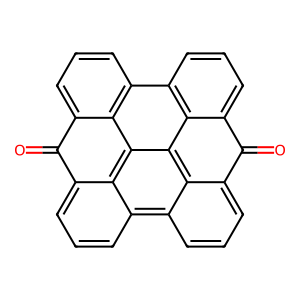
Quinone 7
Names and Identifiers of Quinone 7
CAS Number |
475-64-9 |
|---|---|
IUPAC Name |
octacyclo[13.11.1.12,10.03,8.04,25.019,27.021,26.014,28]octacosa-1(26),2,4(25),5,7,10,12,14(28),15(27),16,18,21,23-tridecaene-9,20-dione |
InChI |
InChI=1S/C28H12O2/c29-27-17-9-1-5-13-14-6-2-11-19-22(14)26-24-16(8-4-12-20(24)28(19)30)15-7-3-10-18(27)23(15)25(26)21(13)17/h1-12H |
InChIKey |
LEEJQTWXRMXYIB-UHFFFAOYSA-N |
Canonical SMILES |
C1=CC2=C3C=CC=C4C3=C5C6=C(C=CC=C6C4=O)C7=C8C5=C2C(=C1)C(=O)C8=CC=C7 |
Physical and chemical properties of Quinone 7
Boiling Point |
733.6±30.0 °C at 760 mmHg |
|---|---|
Density |
1.6±0.1 g/cm3 |
Exact Mass |
380.083740 |
Flash Point |
258.9±21.6 °C |
Index of Refraction |
2.019 |
LogP |
6.93 |
Molecular Formula |
C28H12O2 |
Molecular Weight |
380.394 |
PSA |
34.14000 |
Vapour Pressure |
0.0±2.4 mmHg at 25°C |
Applications of Quinone 7
Quinone 7 finds applications in various fields including organic synthesis, materials science, and medicinal chemistry. Its derivatives are explored for use as antioxidants in food preservation and pharmaceuticals. Additionally, due to their unique electronic properties, quinones are used in dye-sensitized solar cells and as intermediates in the production of complex organic compounds. The potential for developing new drugs targeting oxidative stress-related conditions also highlights its significance in biomedical research.
Interaction Studies of Quinone 7
Interaction studies involving quinone 7 focus on its reactivity with biological macromolecules such as proteins and nucleic acids. Research indicates that quinones can form adducts with thiol groups in proteins, potentially altering their function. These interactions are crucial for understanding the mechanism of action of quinones in biological systems and their role in toxicity or therapeutic efficacy. Furthermore, studies on its interaction with metal ions suggest that quinone 7 could act as a chelating agent, influencing metal ion availability in biological contexts.
Biological Activity of Quinone 7
Quinone 7 has demonstrated notable biological activities. Some derivatives of this compound have shown antioxidant properties, which are crucial for mitigating oxidative stress in biological systems. Studies indicate that certain synthesized derivatives exhibit significant free radical scavenging activity, which may have implications for therapeutic applications in diseases associated with oxidative damage. Moreover, quinones are often involved in biological processes such as electron transport and have roles in cellular respiration.
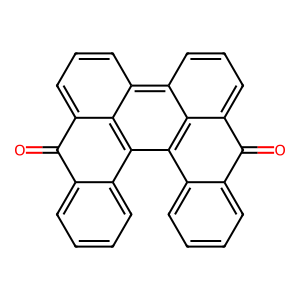 Cas:475-63-8

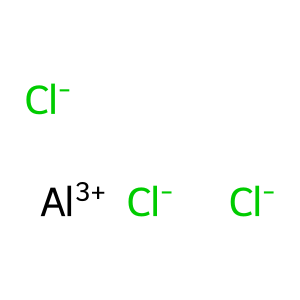 Cas:7446-70-0

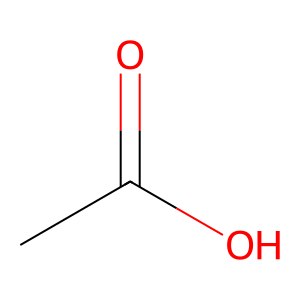 Cas:64-19-7
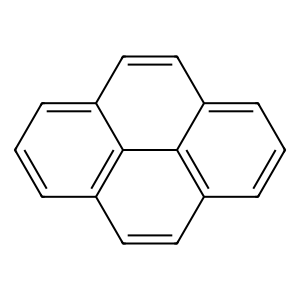 Cas:129-00-0
 Cas:98-88-4