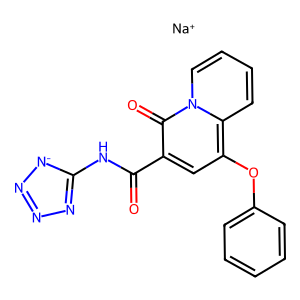
Quinotolast sodium anhydrous
CAS No.:
101193-62-8
M. Wt:
371.30500
M. Fa:
C17H12N6NaO3
InChI Key:
CDPWRMHFRRXOQH-UHFFFAOYSA-M
Names and Identifiers of Quinotolast sodium anhydrous
CAS Number |
101193-62-8 |
|---|---|
IUPAC Name |
sodium;4-oxo-1-phenoxy-N-(1,2,3-triaza-4-azanidacyclopenta-2,5-dien-5-yl)quinolizine-3-carboxamide |
InChI |
InChI=1S/C17H12N6O3.Na/c24-15(18-17-19-21-22-20-17)12-10-14(26-11-6-2-1-3-7-11)13-8-4-5-9-23(13)16(12)25;/h1-10H,(H2,18,19,20,21,22,24);/q;+1/p-1 |
InChIKey |
CDPWRMHFRRXOQH-UHFFFAOYSA-M |
Canonical SMILES |
C1=CC=C(C=C1)OC2=C3C=CC=CN3C(=O)C(=C2)C(=O)NC4=NN=N[N-]4.[Na+] |
UNII |
G8K8E99F1S |
Physical and chemical properties of Quinotolast sodium anhydrous
Exact Mass |
371.08700 |
|---|---|
LogP |
1.93020 |
Molecular Formula |
C17H12N6NaO3 |
Molecular Weight |
371.30500 |
PSA |
114.27000 |
Applications of Quinotolast sodium anhydrous
Quinotolast sodium is utilized across various fields:
- Chemistry: As a model compound for studying histamine receptor inhibition.
- Biology: In research focused on inflammatory mediators in human lung cells.
- Medicine: Investigated for potential therapeutic applications in treating allergic conditions and asthma.
- Industry: Used in the development of anti-allergic drugs.
Interaction Studies of Quinotolast sodium anhydrous
Studies on Quinotolast sodium have highlighted its interactions with various biological systems. It has been shown to effectively inhibit the release of inflammatory mediators from human lung cells. Such interactions underscore its potential in therapeutic settings for managing allergies and asthma.
Similar CompoundsSeveral compounds share similarities with Quinotolast sodium in terms of structure or function. Here are some notable examples:
| Compound Name | Description | Unique Features |
|---|---|---|
| Ketotifen | A mast cell stabilizer used for allergic conditions. | Dual action as both antihistamine and mast cell stabilizer. |
| Montelukast | A leukotriene receptor antagonist used in asthma treatment. | Specifically targets leukotriene pathways. |
| Azelastine | An antihistamine used topically for allergic rhinitis. | Fast onset of action when administered nasally. |
Biological Activity of Quinotolast sodium anhydrous
Quinotolast sodium has been shown to possess significant biological activity, particularly in:
- Anti-allergic Effects: It inhibits the release of key mediators involved in allergic responses.
- Mast Cell Stabilization: The compound acts as a mast cell stabilizer, providing cytoprotective effects on gastric mucosa.