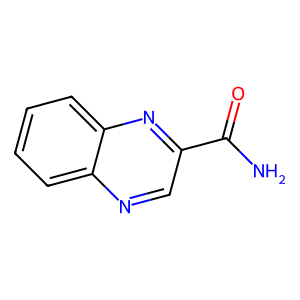
Quinoxaline-2-carboxamide
Names and Identifiers of Quinoxaline-2-carboxamide
CAS Number |
5182-90-1 |
|---|---|
MDL Number |
MFCD01684982 |
IUPAC Name |
quinoxaline-2-carboxamide |
InChI |
InChI=1S/C9H7N3O/c10-9(13)8-5-11-6-3-1-2-4-7(6)12-8/h1-5H,(H2,10,13) |
InChIKey |
CGJMVNVWQHPASW-UHFFFAOYSA-N |
Canonical SMILES |
C1=CC=C2C(=C1)N=CC(=N2)C(=O)N |
UNSPSC Code |
12352100 |
Physical and chemical properties of Quinoxaline-2-carboxamide
Acidity coefficient |
13.93±0.30(Predicted) |
|---|---|
Boiling Point |
430.8±25.0 °C at 760 mmHg |
Density |
1.3±0.1 g/cm3 |
Exact Mass |
173.058914 |
Flash Point |
214.3±23.2 °C |
Index of Refraction |
1.690 |
LogP |
0.98 |
Melting Point |
199-201 °C |
Molecular Formula |
C9H7N3O |
Molecular Weight |
173.171 |
PSA |
68.87000 |
Storage condition |
Sealed in dry,Room Temperature |
Vapour Pressure |
0.0±1.0 mmHg at 25°C |
Safety Information of Quinoxaline-2-carboxamide

Applications of Quinoxaline-2-carboxamide
Quinoxaline-2-carboxamide and its derivatives find applications in various fields:
- Medicinal Chemistry: As potential drugs for treating infections and cancers.
- Agriculture: As agrochemicals due to their antimicrobial properties.
- Material Science: In the development of organic semiconductors and sensors due to their electronic properties.
Interaction Studies of Quinoxaline-2-carboxamide
Interaction studies have demonstrated that quinoxaline-2-carboxamide can bind to DNA and proteins, influencing their structure and function. For instance, studies have shown that it forms stable complexes with platinum compounds, enhancing their cytotoxic activity against tumor cells . Additionally, its ability to interact with biomolecules makes it a valuable tool in drug design and development.
Biological Activity of Quinoxaline-2-carboxamide
Quinoxaline-2-carboxamide exhibits notable biological activities, including antimicrobial, antitumor, and antiparasitic properties. Research has shown that derivatives of quinoxaline-2-carboxamide can inhibit the growth of various cancer cell lines and demonstrate efficacy against Mycobacterium tuberculosis. The compound's mechanism of action often involves interference with DNA replication and repair processes, making it a candidate for developing new therapeutic agents.
Physical sample testing spectrum (NMR) of Quinoxaline-2-carboxamide

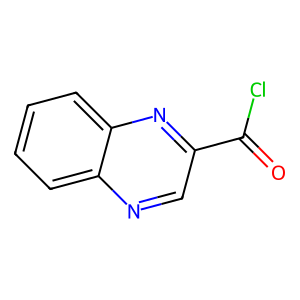 Cas:54745-92-5

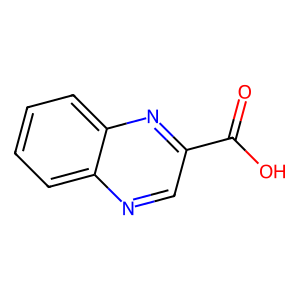 Cas:879-65-2
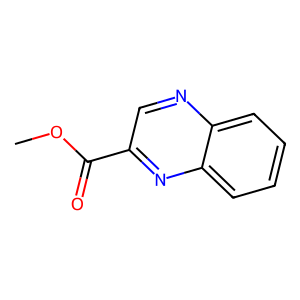 Cas:1865-11-8