
Quinuclidine
Names and Identifiers of Quinuclidine
CAS Number |
100-76-5 |
|---|---|
EC Number |
202-887-1 |
MDL Number |
MFCD00006690 |
IUPAC Name |
1-azabicyclo[2.2.2]octane |
InChI |
InChI=1S/C7H13N/c1-4-8-5-2-7(1)3-6-8/h7H,1-6H2 |
InChIKey |
SBYHFKPVCBCYGV-UHFFFAOYSA-N |
Canonical SMILES |
C1CN2CCC1CC2 |
UNII |
XFX99FC5VI |
UNSPSC Code |
12352100 |
Physical and chemical properties of Quinuclidine
Acidity coefficient |
10.87±0.33(Predicted) |
|---|---|
Boiling Point |
149.5±8.0 °C at 760 mmHg |
BRN |
103111 |
Density |
1.0±0.1 g/cm3 |
Exact Mass |
111.104797 |
Flash Point |
36.5±15.3 °C |
Index of Refraction |
1.513 |
LogP |
1.38 |
Melting Point |
157-160 °C(lit.) |
Merck |
14,8081 |
Molecular Formula |
C7H13N |
Molecular Weight |
111.185 |
PSA |
3.24000 |
Sensitivity |
Air Sensitive |
Solubility |
H2O: very slightly soluble |
Vapour Pressure |
4.0±0.3 mmHg at 25°C |
Water Solubility |
Soluble in alcohol, diethyl ether, water and organic solvents. |
Solubility of Quinuclidine
| Solvent | Dissolution Behavior | Temperature Effect | pH Effect |
|---|---|---|---|
| Water | Slightly soluble (partially dissolves, forming a clear solution) | Heating slightly increases solubility | Significantly increased solubility under acidic conditions (due to protonation) |
| Ethanol | Readily soluble | Heating accelerates dissolution | Less sensitive to pH, but acidic conditions are preferable |
| Acetone | Readily soluble | Slight increase in solubility with rising temperature | Good solubility under neutral or weakly acidic conditions |
| Diethyl ether | Sluggishly soluble | Slight improvement in solubility with increased temperature | Unstable; may decompose under basic conditions |
| Chloroform | Readily soluble | Solubility increases with temperature | Stable under both acidic and basic conditions, no significant effect |
| Dichloromethane | Readily soluble | Solubility increases with temperature | Stable, unaffected by common pH variations |
| Toluene | Practically insoluble | No significant effect | No effect |
| Acetic acid | Readily soluble | Heating promotes dissolution | Acidic environment favors solubility (as it is a base itself) |
| Hydrochloric acid (aqueous solution) | Extremely soluble (forms hydrochloride salt) | Increased temperature speeds up dissolution rate | Completely dissolves under strong acidic conditions, forming stable salts |
Safety Information of Quinuclidine


Key Milestone of Quinuclidine
| Time | Event | Description |
|---|---|---|
| 1886 | First synthesis | German chemist Albert Ladenburg first synthesized quinuclidine through chemical methods, initially as a model compound for studying the structure of quinine. |
| 1930s–1940s | Structure confirmation and naming | With the development of organic chemical structure analysis techniques (such as infrared spectroscopy and X-ray diffraction), the bridged ring structure of quinuclidine (1-azabicyclo[2.2.2]octane) was confirmed, and it was officially named "quinuclidine." |
| 1950s–1960s | Widespread use as an organic synthetic intermediate | Due to its rigid three-dimensional structure and strong basicity (pKa ≈ 11), quinuclidine was widely used in medicinal chemistry as a pharmacophore or conformational constraint unit for constructing molecules with specific stereochemistry. |
| 1970s | Key applications in drug development | The quinuclidine structure was introduced into various drug molecules, such as anticholinergic drugs (e.g., quinuclidine derivatives used to treat Parkinson's disease) and antihistamines, significantly improving the receptor selectivity and metabolic stability of drugs. |
| 1980s–1990s | As catalysts and ligands | Quinuclidine and its derivatives were used as organic catalysts or metal complex ligands in asymmetric synthesis, particularly showing potential in phase transfer catalysis and chiral catalysis. |
| 2000s to present | Ongoing application in modern drug design | Various quinuclidine-containing compounds have entered clinical research, such as candidates for treating Alzheimer's disease, schizophrenia, and pain management. Additionally, its applications in materials science (e.g., ionic liquids, polymer monomers) are being explored. |
Applications of Quinuclidine
Quinuclidine finds applications across various fields:
- Catalysis: It serves as a reagent and catalyst in organic synthesis reactions, particularly in electrophilic addition reactions.
- Pharmaceuticals: Quinuclidine derivatives are explored for therapeutic uses, including treatments for glaucoma and potential neuropharmacological applications.
- Chemical Research: Its unique reactivity makes it a valuable compound for studying reaction mechanisms and developing new synthetic methodologies.
Interaction Studies of Quinuclidine
Studies on quinuclidine interactions have highlighted its ability to form stable complexes with Lewis acids and other electrophiles. The compound's reactivity profile indicates that it can enhance reaction rates when proton donors are present, suggesting a role in autocatalytic processes. Furthermore, quinuclidine's derivatives have been evaluated for their binding affinities to various biological targets, providing insights into their pharmacological potential.
Biological Activity of Quinuclidine
Quinuclidine and its derivatives exhibit notable biological activities, particularly in the realm of pharmacology. Some derivatives are utilized in medicinal chemistry due to their interactions with various receptors. For instance, certain quinuclidine derivatives have been studied for their potential as muscarinic acetylcholinergic receptor ligands. Additionally, compounds derived from quinuclidine have shown promise in treating conditions such as glaucoma, exemplified by aceclidine, which acts on the eye's intraocular pressure.
Physical sample testing spectrum (NMR) of Quinuclidine

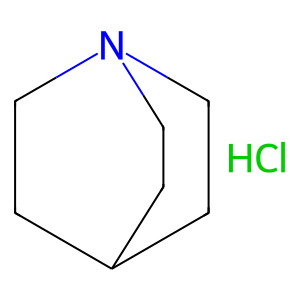 Cas:39896-06-5

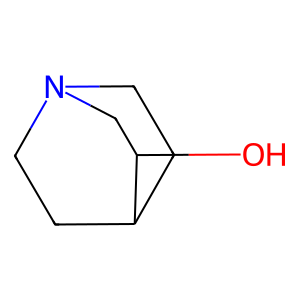 Cas:1619-34-7
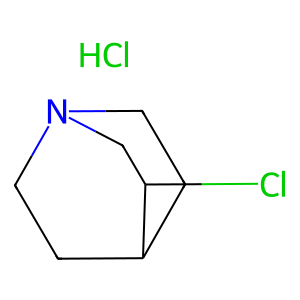 Cas:33601-77-3