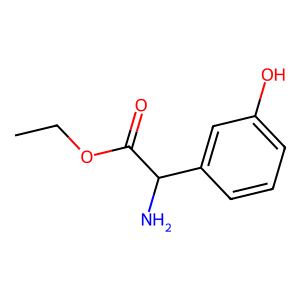
RS-3-hydroxyphenylglycine ethyl ester
Names and Identifiers of RS-3-hydroxyphenylglycine ethyl ester
CAS Number |
536754-45-7 |
|---|---|
IUPAC Name |
ethyl 2-azanyl-2-(3-hydroxyphenyl)ethanoate |
Canonical SMILES |
CCOC(=O)C(C1=CC(=CC=C1)O)N |
Physical and chemical properties of RS-3-hydroxyphenylglycine ethyl ester
Molecular Formula |
C10H13NO3 |
|---|---|
Molecular Weight |
195.21 |
Safety Information of RS-3-hydroxyphenylglycine ethyl ester

Applications of RS-3-hydroxyphenylglycine ethyl ester
Ethyl 2-amino-2-(3-hydroxyphenyl)acetate has various applications across multiple fields:
- Chemistry: It serves as an intermediate in the synthesis of diverse organic compounds.
- Biology: The compound is utilized as a building block for synthesizing biologically active molecules.
- Industry: It finds use in producing fine chemicals and specialty materials, including pharmaceuticals and agrochemicals.
Interaction Studies of RS-3-hydroxyphenylglycine ethyl ester
Studies on ethyl 2-amino-2-(3-hydroxyphenyl)acetate have focused on its interaction with biological targets. The hydroxyphenyl group can participate in hydrogen bonding and π-π interactions, while the amino group can form ionic bonds with negatively charged sites on proteins or enzymes. These interactions may lead to various biological effects, influencing enzyme activity and receptor modulation.
Biological Activity of RS-3-hydroxyphenylglycine ethyl ester
Research indicates that ethyl 2-amino-2-(3-hydroxyphenyl)acetate exhibits promising biological activities. It has been studied for its potential antimicrobial and anti-inflammatory properties, making it a candidate for drug development. The mechanism of action involves interactions with specific molecular targets, where the amino and hydroxy groups facilitate hydrogen bonding and ionic interactions with proteins or enzymes, potentially modulating their activity.