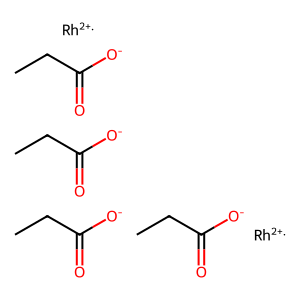
Rhodium(II) propionate
CAS No.:
31126-81-5
M. Wt:
498.093
M. Fa:
C12H20O8Rh2
InChI Key:
FPZUXFCJJLUGLA-UHFFFAOYSA-J
Names and Identifiers of Rhodium(II) propionate
CAS Number |
31126-81-5 |
|---|---|
IUPAC Name |
propanoate;rhodium(2+) |
InChI |
InChI=1S/4C3H6O2.2Rh/c4*1-2-3(4)5;;/h4*2H2,1H3,(H,4,5);;/q;;;;2*+2/p-4 |
InChIKey |
FPZUXFCJJLUGLA-UHFFFAOYSA-J |
Canonical SMILES |
CCC(=O)[O-].CCC(=O)[O-].CCC(=O)[O-].CCC(=O)[O-].[Rh+2].[Rh+2] |
Physical and chemical properties of Rhodium(II) propionate
Exact Mass |
497.926819 |
|---|---|
LogP |
1.61560 |
Molecular Formula |
C12H20O8Rh2 |
Molecular Weight |
498.093 |
PSA |
105.20000 |
Applications of Rhodium(II) propionate
Rhodium(II) propionate has several applications across different fields:
- Catalysis: It is utilized as a catalyst in various organic transformations, including carbene and nitrene transfer reactions.
- Antitumor Research: Due to its biological activity, it is being explored as a potential agent in cancer treatment.
- Enzyme Studies: Its interactions with enzymes make it a valuable tool for studying enzyme mechanisms and inhibition pathways.
Interaction Studies of Rhodium(II) propionate
Research on the interactions of rhodium(II) propionate with biological macromolecules has revealed significant insights into its mechanism of action. Notably:
- Enzyme Inhibition: The compound has been shown to irreversibly inhibit enzymes that contain essential sulfhydryl groups, which may be linked to its cytotoxicity.
- Comparative Studies: Comparative studies among various rhodium(II) carboxylates indicate that rhodium(II) propionate exhibits stronger inhibitory effects on certain enzymes than its counterparts.
Biological Activity of Rhodium(II) propionate
Rhodium(II) propionate exhibits notable biological activity, particularly in the context of antitumor effects. Research indicates that it can irreversibly inhibit certain enzymes, which may correlate with its cytotoxic properties. The compound has been found to be more effective than other rhodium(II) carboxylates, such as rhodium(II) acetate and methoxyacetate, in terms of enzyme inhibition and potential antitumor activity. This suggests a promising avenue for its application in cancer therapeutics.