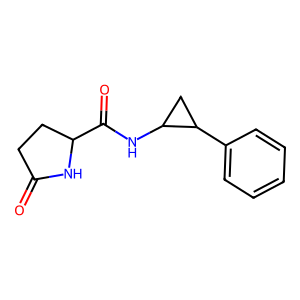
Rolicyprine
Names and Identifiers of Rolicyprine
CAS Number |
2829-19-8 |
|---|---|
IUPAC Name |
5-oxo-N-(2-phenylcyclopropyl)pyrrolidine-2-carboxamide |
InChI |
InChI=1S/C14H16N2O2/c17-13-7-6-11(15-13)14(18)16-12-8-10(12)9-4-2-1-3-5-9/h1-5,10-12H,6-8H2,(H,15,17)(H,16,18) |
InChIKey |
UGSLDMJXBQKDCT-UHFFFAOYSA-N |
Canonical SMILES |
C1CC(=O)NC1C(=O)NC2CC2C3=CC=CC=C3 |
Physical and chemical properties of Rolicyprine
Exact Mass |
244.12100 |
|---|---|
LogP |
1.65700 |
Melting Point |
144-147° |
Molecular Formula |
C14H16N2O2 |
Molecular Weight |
244.28900 |
PSA |
58.20000 |
Specific rotation |
D25 +104.28° (DMF) |
Vapour Pressure |
5.26E-13mmHg at 25°C |
Applications of Rolicyprine
Rolicyprine's primary applications lie within the pharmaceutical industry due to its sodium channel blocking properties. Potential uses include:
- Antiepileptic Drugs: Its ability to stabilize neuronal activity makes it a candidate for developing medications for epilepsy.
- Cardiac Treatments: As a sodium channel blocker, it may be beneficial in treating various cardiac arrhythmias.
- Research: Rolicyprine serves as a valuable tool in studies related to ion channel physiology and pharmacology.
Interaction Studies of Rolicyprine
Studies on rolicyprine's interactions reveal important insights into its pharmacodynamics. Research indicates that rolicyprine interacts with various ion channels, influencing their activity and contributing to its therapeutic effects. The specificity of these interactions is crucial for minimizing side effects while maximizing efficacy in target applications.
Biological Activity of Rolicyprine
Rolicyprine exhibits notable biological activities, primarily as a sodium channel blocker. This property makes it a candidate for therapeutic applications in conditions such as epilepsy and cardiac arrhythmias. The mechanism of action involves the inhibition of sodium ion influx through voltage-gated sodium channels, which can stabilize neuronal membranes and reduce excitability.