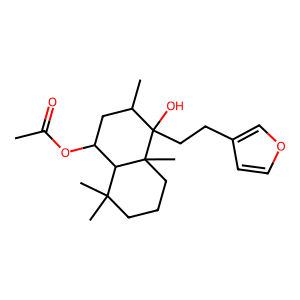
Rotundifuran
Names and Identifiers of Rotundifuran
CAS Number |
50656-65-0 |
|---|---|
IUPAC Name |
[(1R,3R,4R,4aS,8aS)-4-[2-(furan-3-yl)ethyl]-4-hydroxy-3,4a,8,8-tetramethyl-2,3,5,6,7,8a-hexahydro-1H-naphthalen-1-yl] acetate |
InChI |
InChI=1S/C22H34O4/c1-15-13-18(26-16(2)23)19-20(3,4)9-6-10-21(19,5)22(15,24)11-7-17-8-12-25-14-17/h8,12,14-15,18-19,24H,6-7,9-11,13H2,1-5H3/t15-,18-,19+,21+,22-/m1/s1 |
InChIKey |
QKHCQFQIJKXMOE-UGFIEOPBSA-N |
Canonical SMILES |
CC1CC(C2C(CCCC2(C1(CCC3=COC=C3)O)C)(C)C)OC(=O)C |
Isomeric SMILES |
C[C@@H]1C[C@H]([C@@H]2[C@@]([C@]1(CCC3=COC=C3)O)(CCCC2(C)C)C)OC(=O)C |
UNII |
T2UY9AYG4O |
Physical and chemical properties of Rotundifuran
Acidity coefficient |
14.66±0.70(Predicted) |
|---|---|
Boiling Point |
432.9±35.0 °C(Predicted) |
Density |
1.09±0.1 g/cm3(Predicted) |
Exact Mass |
362.24600 |
LogP |
4.74740 |
Molecular Formula |
C22H34O4 |
Molecular Weight |
362.50300 |
PSA |
59.67000 |
Storage condition |
2-8℃ |
Applications of Rotundifuran
Rotundifuran has several applications:
- Pharmaceuticals: Its potential as an anticancer agent makes it valuable in developing cancer therapies.
- Anti-inflammatory Treatments: Due to its ability to modulate inflammatory pathways, it may be used in treating inflammatory diseases.
- Nutraceuticals: Its natural origin allows for incorporation into dietary supplements aimed at enhancing health.
Interaction Studies of Rotundifuran
Studies have explored Rotundifuran's interactions with various biological targets. Notably, it has been identified as a potential target for the Cyr61 protein, which plays a role in cancer progression. Furthermore, it has been shown to sensitize cancer cells to ferroptosis by modulating iron metabolism and reactive oxygen species levels.
Biological Activity of Rotundifuran
Rotundifuran exhibits significant biological activities, particularly in cancer treatment. Research indicates that it induces ferroptotic cell death in lung cancer cells, inhibiting cell growth and promoting apoptosis through various pathways, including the NF-κB and MAPK pathways. Additionally, it has shown potential anti-inflammatory effects by suppressing inflammatory mediators in immune cells.