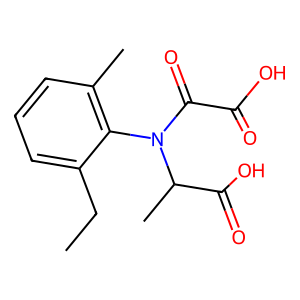
S-Metolachlor CGA 357704
CAS No.:
1217465-10-5
M. Wt:
279.28800
M. Fa:
C14H17NO5
InChI Key:
IMFSUYMDPTXKCC-VIFPVBQESA-N
Names and Identifiers of S-Metolachlor CGA 357704
CAS Number |
1217465-10-5 |
|---|---|
IUPAC Name |
(2S)-2-(2-ethyl-6-methyl-N-oxaloanilino)propanoic acid |
InChI |
InChI=1S/C14H17NO5/c1-4-10-7-5-6-8(2)11(10)15(9(3)13(17)18)12(16)14(19)20/h5-7,9H,4H2,1-3H3,(H,17,18)(H,19,20)/t9-/m0/s1 |
InChIKey |
IMFSUYMDPTXKCC-VIFPVBQESA-N |
Canonical SMILES |
CCC1=CC=CC(=C1N(C(C)C(=O)O)C(=O)C(=O)O)C |
Isomeric SMILES |
CCC1=CC=CC(=C1N([C@@H](C)C(=O)O)C(=O)C(=O)O)C |
Physical and chemical properties of S-Metolachlor CGA 357704
Acidity coefficient |
-0.06±0.54(Predicted) |
|---|---|
Boiling Point |
475.8±55.0 °C(Predicted) |
Density |
1.312±0.06 g/cm3(Predicted) |
Exact Mass |
279.11100 |
LogP |
1.44810 |
Molecular Formula |
C14H17NO5 |
Molecular Weight |
279.28800 |
PSA |
94.91000 |
Safety Information of S-Metolachlor CGA 357704

Applications of S-Metolachlor CGA 357704
(2S)-2-(2-ethyl-6-methyl-N-oxaloanilino)propanoic acid has potential applications in various fields:
- Pharmaceutical Development: Its predicted biological activities make it a candidate for drug development targeting cancer and inflammatory diseases.
- Biochemical Research: It can be used as a probe in studies investigating metabolic pathways or enzyme interactions.
- Nutraceuticals: Given its potential health benefits, it may find use in dietary supplements aimed at improving health outcomes .
Interaction Studies of S-Metolachlor CGA 357704
Interaction studies involving (2S)-2-(2-ethyl-6-methyl-N-oxaloanilino)propanoic acid focus on its binding affinity and efficacy against various biological targets:
- Enzyme Inhibition Studies: Assessing how well the compound inhibits specific enzymes involved in disease pathways.
- Receptor Binding Assays: Investigating its interaction with cellular receptors to understand its mechanism of action.
- Toxicity Assessments: Evaluating potential cytotoxic effects on normal versus cancerous cells to determine therapeutic windows .
Biological Activity of S-Metolachlor CGA 357704
The biological activity of (2S)-2-(2-ethyl-6-methyl-N-oxaloanilino)propanoic acid has been predicted through computational methods that analyze structure-activity relationships. Such predictions indicate potential therapeutic applications, particularly in areas such as:
- Anticancer Activity: Compounds with similar structures have shown promise in inhibiting tumor growth and proliferation.
- Anti-inflammatory Effects: The compound may exhibit properties that reduce inflammation, making it a candidate for treating inflammatory diseases.
- Antioxidant Properties: It could potentially scavenge free radicals, providing protective effects against oxidative stress .