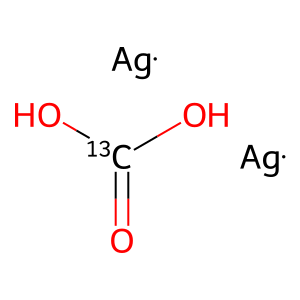
SILVER CARBONATE-13C
Names and Identifiers of SILVER CARBONATE-13C
CAS Number |
85323-65-5 |
|---|---|
IUPAC Name |
bis(oxidanyl)(113C)methanone;silver |
Canonical SMILES |
[13C](=O)(O)O.[Ag].[Ag] |
Physical and chemical properties of SILVER CARBONATE-13C
Exact Mass |
276.81400 |
|---|---|
LogP |
0.22240 |
Molecular Formula |
CH2Ag2O3 |
Molecular Weight |
278.75400 |
PSA |
57.53000 |
Safety Information of SILVER CARBONATE-13C

Applications of SILVER CARBONATE-13C
Dihydroxy(113C)methanone;silver may find applications across various fields:
- Antimicrobial Agents: Used in medical devices and coatings due to its bactericidal properties.
- Catalysts: In organic synthesis reactions where silver acts as a catalyst for specific transformations.
- Photographic Materials: Silver compounds are historically significant in photography; similar compounds may be employed in modern imaging technologies.
These applications leverage the unique properties of silver and its compounds, particularly their stability and reactivity under specific conditions.
Interaction Studies of SILVER CARBONATE-13C
Interaction studies involving dihydroxy(113C)methanone;silver would focus on its reactivity with biological systems and other chemical species. These studies typically assess:
- Binding Affinity: How well the compound interacts with proteins or nucleic acids.
- Toxicity Assessments: Evaluating the safety profile when used in biological settings.
- Synergistic Effects: Examining whether combining this compound with other antimicrobial agents enhances efficacy.
Such studies are crucial for determining practical applications in medicine and materials science.
Biological Activity of SILVER CARBONATE-13C
Silver compounds are recognized for their antimicrobial properties, which are attributed to their ability to disrupt cellular functions in bacteria and fungi. The mechanism typically involves the release of silver ions that can bind to cellular components such as proteins and DNA, leading to cell death. Dihydroxy(113C)methanone;silver may exhibit similar biological activities, making it a candidate for applications in wound dressings and antiseptics. Studies have shown that silver nanoparticles and ions can effectively inhibit the growth of various pathogens, including antibiotic-resistant strains.