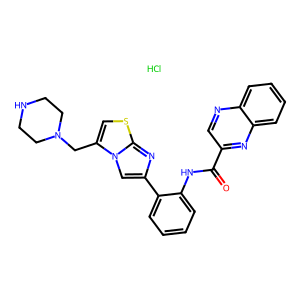
SRT 1720 Hydrochloride
Names and Identifiers of SRT 1720 Hydrochloride
CAS Number |
1001645-58-4 |
|---|---|
IUPAC Name |
N-[2-[3-(piperazin-1-ylmethyl)imidazo[2,1-b][1,3]thiazol-6-yl]phenyl]quinoxaline-2-carboxamide;hydrochloride |
InChI |
InChI=1S/C25H23N7OS.ClH/c33-24(22-13-27-20-7-3-4-8-21(20)28-22)29-19-6-2-1-5-18(19)23-15-32-17(16-34-25(32)30-23)14-31-11-9-26-10-12-31;/h1-8,13,15-16,26H,9-12,14H2,(H,29,33);1H |
InChIKey |
DTGRRMPPXCRRIM-UHFFFAOYSA-N |
Canonical SMILES |
C1CN(CCN1)CC2=CSC3=NC(=CN23)C4=CC=CC=C4NC(=O)C5=NC6=CC=CC=C6N=C5.Cl |
Physical and chemical properties of SRT 1720 Hydrochloride
Density |
1.58 |
|---|---|
Exact Mass |
505.145142 |
LogP |
4.80520 |
Melting Point |
>205°C (dec.) |
Molecular Formula |
C25H23N7OS.xHCl |
Molecular Weight |
506.022 |
PSA |
115.69000 |
Solubility |
Soluble in DMSO (>25 mg/ml) |
Stability |
Stable for 1 year from date of purchase as supplied. Solutions in DMSO may be stored at -20°C for up to 3 months. |
Storage condition |
= -70C |
Solubility of SRT 1720 Hydrochloride
| Solvent | Dissolution Behavior | Temperature Effect | pH Effect |
|---|---|---|---|
| Water | Practically insoluble (very poor solubility) | Solubility slightly improves with increased temperature, but remains very low | Still poorly soluble under acidic or neutral conditions; alkaline conditions may slightly enhance solubility (due to phenolic hydroxyl groups), but compound stability is compromised |
| Dimethyl sulfoxide (DMSO) | Highly soluble; commonly used as a stock solution solvent | Dissolves rapidly with increasing temperature; typically fully dissolves at room temperature | Essentially unaffected by pH; suitable for preparing high-concentration stock solutions |
| Ethanol | Slightly soluble to soluble (concentration-dependent) | Heating significantly increases solubility | Stable under weakly acidic or neutral conditions; may degrade under strongly acidic or basic conditions |
| Methanol | Soluble | Increased temperature enhances dissolution | Similar to ethanol; may decompose under extreme pH conditions |
| Acetone | Soluble | Dissolves quickly; effect of heating is evident | Unaffected by pH, but may be unstable upon long-term storage |
| Chloroform | Soluble | Dissolves well at room temperature | Minimal influence from pH; suitable for extraction applications |
| Ethyl acetate | Moderately soluble | Higher temperatures aid dissolution | Little pH sensitivity; commonly used in organic-phase extractions |
Key Milestone of SRT 1720 Hydrochloride
| Year | Milestone | Description |
|---|---|---|
| 2008 | First Report & Discovery | Researchers at Sirtris Pharmaceuticals (a GSK subsidiary) first reported SRT1720 in Nature as a small-molecule activator of SIRT1 (sirtuin 1 deacetylase) with greater potency and selectivity than resveratrol. |
| 2009–2010 | Expanded Preclinical Studies | Numerous animal studies showed that SRT1720 improved insulin sensitivity, lowered blood glucose, and extended healthspan in models of obesity, type 2 diabetes, and metabolic syndrome. |
| 2010 | GSK Halts Development | GlaxoSmithKline suspended clinical development of the Sirtris compounds, including SRT1720, citing toxicological findings (e.g., potential hepatotoxicity), pharmacokinetic issues, and scientific debate over the mechanism of SIRT1 activation. |
| 2011–2013 | Mechanistic Controversy & Academic Research | Several independent groups questioned whether SRT1720 directly activates SIRT1, noting that its activity appeared to depend on fluorogenic substrates (e.g., Fluor de Lys) and was unclear on physiological substrates; other studies still supported its in vivo metabolic benefits. |
| 2013 | Independent Validation Published | A multi-center study led by the U.S. National Institute on Aging (NIA) and published in Science showed that SRT1720 improved metabolic health in high-fat-diet mice but did not significantly extend lifespan. |
| 2014–2018 | Ongoing Academic Exploration | Despite never entering the clinic, SRT1720 became a widely used tool compound for probing SIRT1 function in aging, inflammation, neurodegeneration, and cancer. |
| 2019–Present | Widespread Use as Research Tool | SRT1720 is now a standard chemical probe in aging and metabolism research, advancing understanding of the sirtuin family and informing the design of next-generation SIRT1 activators. |
Applications of SRT 1720 Hydrochloride
N-[2-[3-(piperazin-1-ylmethyl)imidazo[2,1-b][1,3]thiazol-6-yl]phenyl]quinoxaline-2-carboxamide; hydrochloride has several applications:
- Therapeutic Agent: It is primarily explored for its potential in treating metabolic disorders such as type 2 diabetes due to its ability to enhance insulin sensitivity.
- Research Tool: In pharmacological studies, it serves as a valuable tool for investigating the role of histone deacetylases in cellular processes.
Interaction Studies of SRT 1720 Hydrochloride
Studies have shown that N-[2-[3-(piperazin-1-ylmethyl)imidazo[2,1-b][1,3]thiazol-6-yl]phenyl]quinoxaline-2-carboxamide interacts with various biological targets. Its activation of NAD(+)-dependent histone deacetylases suggests a mechanism through which it can influence gene expression and metabolic pathways. Additionally, interaction studies indicate that this compound may affect signaling pathways related to cell growth and apoptosis.
Biological Activity of SRT 1720 Hydrochloride
This compound exhibits notable biological activities, particularly as an activator of NAD(+)-dependent histone deacetylases. Such activity is crucial for the regulation of gene expression and has implications in the treatment of metabolic disorders, including type 2 diabetes. By enhancing insulin sensitivity and promoting glucose homeostasis, N-[2-[3-(piperazin-1-ylmethyl)imidazo[2,1-b][1,3]thiazol-6-yl]phenyl]quinoxaline-2-carboxamide may serve as a therapeutic agent in metabolic syndrome management.
Physical sample testing spectrum (NMR) of SRT 1720 Hydrochloride
