
Saflufenacil
Names and Identifiers of Saflufenacil
CAS Number |
372137-35-4 |
|---|---|
IUPAC Name |
2-chloranyl-4-fluoranyl-5-[3-methyl-2,6-bis(oxidanylidene)-4-(trifluoromethyl)pyrimidin-1-yl]-N-[methyl(propan-2-yl)sulfamoyl]benzamide |
Canonical SMILES |
CC(C)N(C)S(=O)(=O)NC(=O)C1=CC(=C(C=C1Cl)F)N2C(=O)C=C(N(C2=O)C)C(F)(F)F |
Physical and chemical properties of Saflufenacil
Acidity coefficient |
4.24±0.40(Predicted) |
|---|---|
BRN |
11326826 |
Density |
1.542g/cm3 |
Exact Mass |
500.05400 |
Index of Refraction |
1.56 |
LogP |
3.31790 |
Melting Point |
189.9-193.4 °C |
Molecular Formula |
C17H17ClF4N4O5S |
Molecular Weight |
500.85200 |
PSA |
122.35000 |
Safety Information of Saflufenacil


Applications of Saflufenacil
Saflufenacil is widely utilized in agriculture for its effectiveness against broadleaf weeds. It is registered for use in various crops, including:
- Soybeans
- Corn
- Fruit trees
- Nut trees
- Vineyards
The application methods include pre-plant and pre-emergence treatments, as well as desiccation prior to harvest . Annual usage estimates indicate significant application rates, particularly in corn and soybean cultivation .
Interaction Studies of Saflufenacil
Research indicates that saflufenacil has low acute toxicity through oral, dermal, and inhalation routes . In metabolism studies involving rats, it was found that the compound is well absorbed and rapidly excreted, with significant differences noted between male and female rats regarding excretion pathways . The primary metabolites identified include M800H01, M800H03, and M800H07, which are crucial for understanding its safety profile and environmental impact .
Biological Activity of Saflufenacil
As a herbicide, saflufenacil exhibits potent biological activity against a range of broadleaf weeds. It acts by accumulating protoporphyrin IX, which is a photosensitizer that activates oxygen, leading to lipid peroxidation and cell membrane damage . This mechanism results in visible symptoms such as chlorosis and necrosis in susceptible plants while showing selectivity in crops like corn and soybeans, where it causes minimal damage .
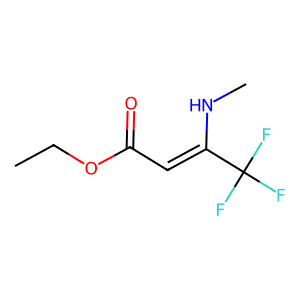 Cas:121303-76-2

 Cas:685568-56-3
