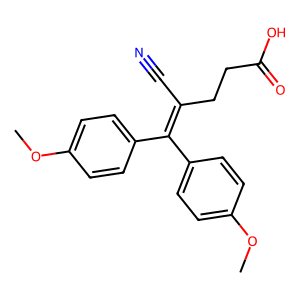
Satigrel
Names and Identifiers of Satigrel
CAS Number |
111753-73-2 |
|---|---|
IUPAC Name |
4-cyano-5,5-bis(4-methoxyphenyl)pent-4-enoic acid |
InChI |
InChI=1S/C20H19NO4/c1-24-17-8-3-14(4-9-17)20(16(13-21)7-12-19(22)23)15-5-10-18(25-2)11-6-15/h3-6,8-11H,7,12H2,1-2H3,(H,22,23) |
InChIKey |
GRVCTHTXJDYIHB-UHFFFAOYSA-N |
Canonical SMILES |
COC1=CC=C(C=C1)C(=C(CCC(=O)O)C#N)C2=CC=C(C=C2)OC |
UNII |
XPV71VQL72 |
Physical and chemical properties of Satigrel
Boiling Point |
581.6ºC at 760mmHg |
|---|---|
Density |
1.195g/cm3 |
Exact Mass |
337.13100 |
Flash Point |
305.6ºC |
Index of Refraction |
1.578 |
LogP |
3.89408 |
Melting Point |
124-125° |
Molecular Formula |
C20H19NO4 |
Molecular Weight |
337.36900 |
PSA |
79.55000 |
Vapour Pressure |
2.27E-14mmHg at 25°C |
Applications of Satigrel
Satigrel is primarily used in:
- Cardiovascular Medicine: As an anti-platelet agent, it is utilized to prevent thrombotic events in patients with a history of heart disease.
- Research: Its unique properties make it a subject of study in pharmacology and medicinal chemistry, particularly concerning its mechanisms of action and potential new applications.
Interaction Studies of Satigrel
Studies on Satigrel's interactions reveal that it may interact with other medications that affect platelet function or coagulation pathways. Understanding these interactions is essential for optimizing therapeutic regimens and minimizing adverse effects. Clinical trials often assess these interactions to ensure patient safety and efficacy when combined with other treatments.
Biological Activity of Satigrel
Satigrel primarily exhibits anti-platelet activity. It works by inhibiting the aggregation of platelets, which is crucial in preventing clot formation. This mechanism is particularly beneficial for patients at risk of cardiovascular events. Research indicates that Satigrel may also influence other pathways involved in vascular health, although detailed studies are still ongoing to fully elucidate its biological effects.