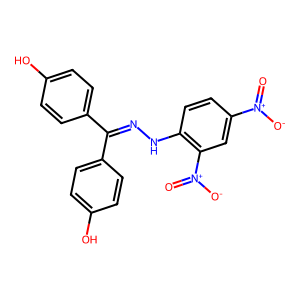
Sivifene
Names and Identifiers of Sivifene
CAS Number |
2675-35-6 |
|---|---|
IUPAC Name |
4-[N-(2,4-dinitroanilino)-C-(4-hydroxyphenyl)carbonimidoyl]phenol |
InChI |
InChI=1S/C19H14N4O6/c24-15-6-1-12(2-7-15)19(13-3-8-16(25)9-4-13)21-20-17-10-5-14(22(26)27)11-18(17)23(28)29/h1-11,20,24-25H |
InChIKey |
YOQPCWIXYUNEET-UHFFFAOYSA-N |
Canonical SMILES |
C1=CC(=CC=C1C(=NNC2=C(C=C(C=C2)[N+](=O)[O-])[N+](=O)[O-])C3=CC=C(C=C3)O)O |
UNII |
XAV05295I5 |
Physical and chemical properties of Sivifene
Density |
1.47 |
|---|---|
Exact Mass |
394.09100 |
LogP |
4.89810 |
Molecular Formula |
C19H14N4O6 |
Molecular Weight |
394.33800 |
PSA |
156.49000 |
Applications of Sivifene
Sivifene's primary applications are in medicinal chemistry and pharmaceuticals. Its potential uses include:
- Cancer Treatment: Investigated for its role in treating cervical cancer and skin cancers.
- Immune Modulation: Potentially enhances local immune responses against viral infections.
- Analytical Chemistry: Used as a reagent in qualitative organic analysis to detect carbonyl compounds through hydrazone formation.
Interaction Studies of Sivifene
Research on Sivifene's interactions primarily focuses on its biochemical pathways and effects on cellular mechanisms. Studies indicate that it may interact with various cellular targets involved in immune response modulation and apoptosis in cancer cells. Further exploration is needed to fully understand its pharmacodynamics and potential side effects when used therapeutically.
Biological Activity of Sivifene
Sivifene exhibits notable biological activity, particularly in oncology. It has been investigated for its efficacy in treating cervical dysplasia and cancer by enhancing immune responses against viral infections associated with cancer development. Studies suggest that Sivifene may stimulate local immune mechanisms, making it a candidate for therapeutic applications against human papillomavirus-related conditions.
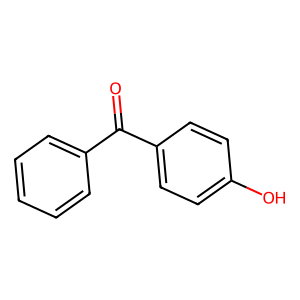 Cas:1137-42-4

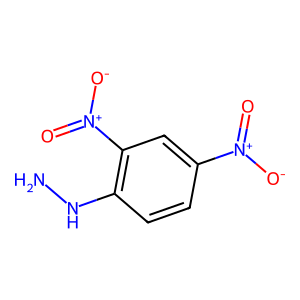 Cas:119-26-6
