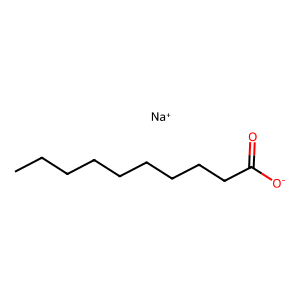
Sodium decanoate
Names and Identifiers of Sodium decanoate
CAS Number |
1002-62-6 |
|---|---|
EC Number |
213-688-4 |
MDL Number |
MFCD00066453 |
IUPAC Name |
sodium;decanoate |
InChI |
InChI=1S/C10H20O2.Na/c1-2-3-4-5-6-7-8-9-10(11)12;/h2-9H2,1H3,(H,11,12);/q;+1/p-1 |
InChIKey |
FIWQZURFGYXCEO-UHFFFAOYSA-M |
Canonical SMILES |
CCCCCCCCCC(=O)[O-].[Na+] |
UNII |
4I820XKV2A |
UNSPSC Code |
12352100 |
Physical and chemical properties of Sodium decanoate
Boiling Point |
269.6ºC at 760 mmHg |
|---|---|
BRN |
3572742 |
Exact Mass |
194.128281 |
Flash Point |
121.8ºC |
LogP |
1.87700 |
Melting Point |
~240 °C (dec.) |
Molecular Formula |
C10H19NaO2 |
Molecular Weight |
194.246 |
PSA |
40.13000 |
Solubility |
H2O: 0.1 g/mL, clear, colorless |
Storage condition |
2-8°C |
Vapour Pressure |
0.00355mmHg at 25°C |
Water Solubility |
H2O: 0.1 g/mL, clear, colorless |
Solubility of Sodium decanoate
| Solvent | Dissolution Behavior | Temperature Effect | pH Effect |
|---|---|---|---|
| Water | Soluble, forming a clear solution; good solubility due to the hydrophilic carboxylate sodium group | Increasing temperature significantly enhances solubility and dissolution rate | Stable under neutral to weakly alkaline conditions; decomposes into decanoic acid (insoluble in water, precipitates) under acidic conditions |
| Ethanol | Soluble, but with lower solubility than water; solubility improves with heating | Elevated temperature promotes dissolution, especially evident under reflux conditions | Prone to esterification or precipitation of free acid under acidic conditions, reducing solubility |
| Acetone | Slightly soluble or partially dissolved, low solubility, often forms turbid solutions or phase separation | Higher temperature slightly improves solubility, but the improvement is limited | Acidic environments may cause hydrolysis or decomposition, affecting stability |
| Diethyl ether | Almost insoluble, very low solubility, may form emulsions or phase separation | Temperature has little effect; remains poorly soluble | Not highly sensitive, but acidic conditions may trigger side reactions |
| Glycerol | Soluble, forming a homogeneous solution; better solubility compared to acetone and diethyl ether | Increased temperature aids dissolution, especially with heating and stirring | Good stability, but may undergo hydrolysis under strongly acidic conditions |
| Toluene | Insoluble, immiscible with organic phase, leading to phase separation | No significant improvement with increased temperature | No obvious effect, but strong acids or bases can degrade the molecular structure |
Routine testing items of Sodium decanoate
| Test Item | Common Testing Methods | Method Overview |
|---|---|---|
| Appearance | Visual Inspection | Observe the color, physical state, and presence of visible impurities. Typically appears as a white to off-white powder or granules. |
| Identification | Fourier Transform Infrared Spectroscopy (FT-IR) | Compare the sample's spectrum with a reference standard to confirm the presence of characteristic molecular absorption peaks, verifying the identity of sodium caprate. |
| Assay | High-Performance Liquid Chromatography (HPLC) | Utilize a reversed-phase chromatography column with a UV detector; identify components by retention time and quantify by peak area to accurately determine the main ingredient content of sodium caprate. |
| Acid Value / Base Value | Acid-Base Titration | Dissolve the sample and titrate with standardized hydrochloric acid solution to calculate free base or residual acid content, reflecting purity and degree of neutralization. |
| Water Content | Karl Fischer Titration | Employ a specific reaction for water determination to measure trace moisture content accurately. |
| pH Value | pH Meter Method | Prepare a defined aqueous solution (e.g., 1%) and measure its pH using a calibrated pH meter to assess product stability. |
| Heavy Metals | Atomic Absorption Spectroscopy (AAS) or ICP-MS | After sample digestion, determine concentrations of heavy metal elements such as lead, arsenic, cadmium, and mercury to ensure compliance with pharmacopeial or food safety standards. |
| Residue on Ignition | Ignition Method (Sulfated Ash) | Incinerate the sample at high temperature followed by sulfuric acid treatment, then weigh the residual ash to evaluate total inorganic impurity content. |
| Microbial Limits | Microbial Limit Test | Perform assays according to pharmacopeial requirements, including total aerobic microbial count, mold and yeast counts, and tests for specified control organisms (e.g., Escherichia coli). |
| Particle Size Distribution | Laser Diffraction Particle Size Analysis | Measure particle size and distribution using laser scattering principles, suitable for controlling the physical properties of powdered products. |
Safety Information of Sodium decanoate
Key Milestone of Sodium decanoate
| Year | Milestone Event | Description |
|---|---|---|
| Late 19th Century | Preliminary Synthesis and Identification of Compounds | Sodium caprate, as the sodium salt of capric acid (Capric acid), was first isolated and synthesized during the research boom on fatty acids. With the development of organic chemistry, the structures of long-chain fatty acids and their salts were clarified. |
| 1930s–1950s | Initial Applications in Food and Daily Chemical Industries | Due to its surfactant and emulsifying properties, sodium caprate began to be explored for use as a food additive (e.g., emulsifier) and in soaps and detergents for daily chemicals. |
| 1970s | Potential in Drug Delivery Systems Discovered | Studies revealed that sodium caprate could enhance intestinal absorption of certain drugs, especially small-molecule peptide drugs, preliminarily demonstrating its role as an absorption enhancer. |
| 1985 | Confirmed as an Effective Transmembrane Absorption Enhancer | Multiple studies showed that sodium caprate can significantly increase the bioavailability of oral drugs (e.g., insulin, heparin) by modulating paracellular permeability (opening tight junctions). |
| 1990s | Entered Preclinical and Clinical Research Phases | Sodium caprate was used in multiple oral formulation development projects, particularly in the field of peptide drug delivery, becoming a research hotspot. For example, it was tested in oral anticoagulant and vaccine formulations. |
| Early 2000s | Became a Key Excipient in Novel Drug Delivery Systems | With the development of nanocarriers and controlled-release technologies, sodium caprate was integrated into microspheres, micelles, liposomes, and other systems to improve gastrointestinal drug permeability. |
| 2010 | Received GRAS Certification (Generally Recognized as Safe) | The U.S. FDA recognized the safety of sodium caprate at specific dosages as a food additive, paving the way for its application in functional foods and nutritional supplements. |
| 2016 | Participated in the First Oral Peptide Drug Clinical Trial | In a clinical trial targeting an oral GLP-1 analog, sodium caprate significantly improved drug absorption as an absorption enhancer, promoting the development of non-injectable diabetes treatments. |
| 2020 to Present | Commercialization Advancement of Novel Oral Formulations | Several pharmaceutical companies (e.g., Novo Nordisk, Emisphere Technologies) have incorporated sodium caprate or its derivatives into their oral drug platforms, advancing products such as oral insulin into late-stage clinical trials. |
Applications of Sodium decanoate
Sodium decanoate has diverse applications across various fields:
- Pharmaceuticals: Used as an excipient in drug formulations to enhance solubility and bioavailability.
- Food Industry: Acts as an emulsifier and preservative in food products.
- Cosmetics: Utilized in personal care products for its emulsifying properties.
- Environmental Chemistry: Employed for the selective precipitation of metal ions from industrial wastewater.
- Research: Serves as a biochemical reagent in life sciences research.
Interaction Studies of Sodium decanoate
Studies have investigated the interactions of sodium decanoate with various biological systems. Its ability to form micelles allows for enhanced interaction with hydrophobic drugs, facilitating their delivery within biological environments. Additionally, research indicates that sodium decanoate may influence cellular uptake mechanisms, enhancing the effectiveness of therapeutic agents.
Biological Activity of Sodium decanoate
Sodium decanoate exhibits notable biological activities, particularly in the context of its use as a biochemical reagent. It has been studied for its potential in drug delivery systems due to its ability to facilitate the transport of therapeutic agents across biological membranes. Furthermore, it has shown promise in enhancing the solubility and bioavailability of poorly soluble drugs. Research indicates that sodium decanoate may also have antimicrobial properties, making it a candidate for use in pharmaceutical formulations.
Physical sample testing spectrum (NMR) of Sodium decanoate

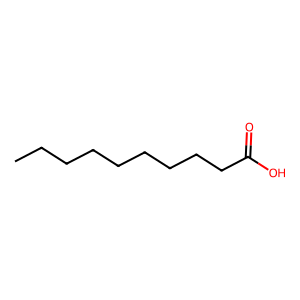 Cas:334-48-5

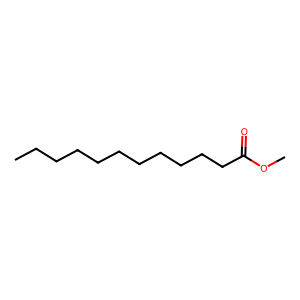 Cas:111-82-0
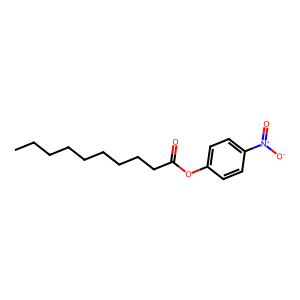 Cas:1956-09-8