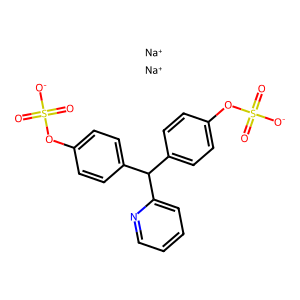
Sodium picosulfate
CAS No.:
10040-45-6
M. Wt:
499.42
M. Fa:
C18H13NNa2O8S2.H2O
InChI Key:
GOZDTZWAMGHLDY-UHFFFAOYSA-L
Appearance:
White to Off-white Solid
Names and Identifiers of Sodium picosulfate
CAS Number |
10040-45-6 |
|---|---|
EC Number |
233-120-9 |
IUPAC Name |
disodium;[4-[pyridin-2-yl-(4-sulfonatooxyphenyl)methyl]phenyl] sulfate |
InChI |
InChI=1S/C18H15NO8S2.2Na/c20-28(21,22)26-15-8-4-13(5-9-15)18(17-3-1-2-12-19-17)14-6-10-16(11-7-14)27-29(23,24)25;;/h1-12,18H,(H,20,21,22)(H,23,24,25);;/q;2*+1/p-2 |
InChIKey |
GOZDTZWAMGHLDY-UHFFFAOYSA-L |
Canonical SMILES |
C1=CC=NC(=C1)C(C2=CC=C(C=C2)OS(=O)(=O)[O-])C3=CC=C(C=C3)OS(=O)(=O)[O-].[Na+].[Na+] |
UNII |
VW106606Y8 |
Physical and chemical properties of Sodium picosulfate
LogP |
4.10140 |
|---|---|
Melting Point |
272 - 275ºC |
Molecular Formula |
C18H13NNa2O8S2.H2O |
Molecular Weight |
499.42 |
PSA |
162.51000 |
Solubility |
Freely soluble in water, slightly soluble in ethanol 96 per cent. |
Stability |
Hygroscopic |
Storage condition |
Hygroscopic, Refrigerator, Under Inert Atmosphere |
Water Solubility |
Freely soluble in water, slightly soluble in ethanol 96 per cent. |
Solubility of Sodium picosulfate
| Solvent | Dissolution Behavior | Effect of Temperature | Effect of pH |
|---|---|---|---|
| Water | Readily soluble, forms a clear solution | Increasing temperature significantly enhances solubility | Optimal solubility under neutral to slightly basic conditions; may hydrolyze or precipitate under strongly acidic or basic conditions |
| Ethanol (95%) | Sparingly soluble, partially dissolves, solution is slightly cloudy | Increasing temperature slightly improves solubility | Solubility decreases under acidic conditions; slightly increases under basic conditions |
| Methanol | Soluble, forms a clear solution | Increasing temperature promotes dissolution | Similar to water; stable and soluble under neutral to slightly basic conditions |
| Acetone | Nearly insoluble, precipitation or cloudiness occurs | Temperature has negligible effect | Unaffected by pH; however, high pH may lead to side reactions |
| Diethyl ether | Insoluble, distinct layering observed | No significant effect | No effect |
| Chloroform | Insoluble, forms emulsion or layering | No significant effect | No effect |
| Dimethyl sulfoxide (DMSO) | Highly soluble, forms a clear solution | Increasing temperature further enhances solubility | Stable over a wide pH range |
Safety Information of Sodium picosulfate

Key Milestone of Sodium picosulfate
| Time | Event | Description |
|---|---|---|
| Late 1950s | First Synthesis and Structural Confirmation | Sodium picosulfate was first synthesized by German scientists during research on laxative compounds. Its chemical structure was confirmed as the sodium sulfate salt of 4,4'-(2-pyridylmethylene)bis(2,6-dimethylphenol). |
| 1964 | First Market Approval (Germany) | Launched by Boehringer Ingelheim in Germany under the brand name "Laxoberal" for constipation treatment, marking its entry into clinical use. |
| 1970s | Mechanism of Action Elucidated | Studies confirmed sodium picosulfate is a prodrug metabolized by gut microbiota in the colon into its active form (bis-(p-hydroxyphenyl)-pyridyl-2-methane, BHPM), stimulating colonic motility and increasing fluid secretion. |
| 1980s–1990s | Global Expansion | Approved in Europe, Asia, Latin America, and other regions for chronic constipation, becoming a widely used laxative. |
| Early 2000s | Use in Bowel Preparation | Began application for bowel cleansing before colonoscopy or surgery, often combined with magnesium salts (e.g., magnesium oxide, citrate) in formulations like Picolax® or Prepopik®. |
| 2012 | FDA Approval of Combination Product | U.S. FDA approved sodium picosulfate/magnesium oxide/citric acid oral solution (brand name Prepopik®) for adult bowel preparation prior to colonoscopy. |
| 2010s–Present | Safety and Guideline Recognition | Multiple studies confirmed its safety in elderly and specific populations; endorsed by international guidelines (e.g., ESGE) as an effective bowel preparation option. |
| 2020s | New Formulations and Combination Studies | Research on lower-dose formulations with reduced side effects and optimized combinations (e.g., with PEG) to improve patient tolerance and compliance. |
Applications of Sodium picosulfate
Sodium picosulfate is primarily used in:
- Laxatives: It is commonly included in formulations for bowel preparation before surgeries or diagnostic procedures like colonoscopy.
- Constipation Treatment: It serves as an effective treatment for individuals suffering from constipation due to its stimulant properties.
The combination of sodium picosulfate with other agents like magnesium oxide and citric acid enhances its effectiveness for bowel cleansing .
Interaction Studies of Sodium picosulfate
Sodium picosulfate may interact with other medications and substances. Notably:
- Electrolyte disturbances: Use of sodium picosulfate can lead to imbalances such as hyponatremia and hypokalemia due to increased fluid loss during bowel evacuation.
- Drug interactions: It may affect the absorption of other medications taken concurrently; therefore, patients are advised to inform healthcare providers about all medications they are using .
Biological Activity of Sodium picosulfate
Sodium picosulfate's primary biological activity is its function as a laxative. After oral administration, it is metabolized by gut bacteria into an active form that stimulates the intestinal lining, leading to increased motility and bowel evacuation. The compound enhances the secretion of water and electrolytes into the intestinal lumen, aiding in stool softening and promoting bowel movements . The typical onset of action occurs within 12 to 24 hours after ingestion .
Physical sample testing spectrum (NMR) of Sodium picosulfate
