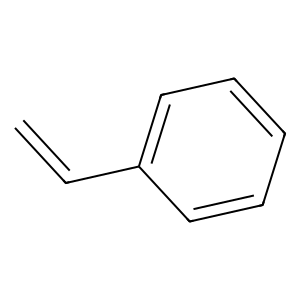
Styrene
Names and Identifiers of Styrene
CAS Number |
100-42-5 |
|---|---|
EC Number |
202-851-5 |
MDL Number |
MFCD00008612 |
IUPAC Name |
styrene |
InChI |
InChI=1S/C8H8/c1-2-8-6-4-3-5-7-8/h2-7H,1H2 |
InChIKey |
PPBRXRYQALVLMV-UHFFFAOYSA-N |
Canonical SMILES |
C=CC1=CC=CC=C1 |
UNII |
44LJ2U959V |
UNSPSC Code |
12352100 |
UN Number |
2055 |
Physical and chemical properties of Styrene
Acidity coefficient |
>14 (Schwarzenbach et al., 1993) |
|---|---|
Boiling Point |
293 °F |
BRN |
1071236 |
carcinogen classification |
2A (Vol. 60, 82, 121) 2019 |
Decomposition |
When heated to decomposition it emits acrid smoke and irritating fumes. |
Density |
0.91 |
Exact Mass |
104.062599 |
explosive limit |
1.1-8.9%(V) |
Flash Point |
88 °F |
Freezing Point |
-30.6℃ |
Index of Refraction |
Index of refraction: 1.5440 at 25 °C |
LogP |
3.0 |
Melting Point |
-23 °F |
Merck |
14,8860 |
Molecular Formula |
C8H8 |
Molecular Weight |
104.149 |
Odor |
If pure, sweet and pleasant, but usually contains aldehydes that have a typical penetrating smell, sharp, sweet, and unpleasant. |
Odor Threshold |
0.035ppm |
Sensitivity |
Air Sensitive |
Solubility |
0.32g/L at 25°C in Water |
Stability |
Stable, but may polymerize upon exposure to light. Normally shipped with a dissolved inhibitor. Substances to be avoided include strong acids, aluminium chloride, strong oxidizing agents, copper, copper alloys, metallic salts, polymerization catalysts and accelerators. Flammable - vapour may travel considerable distance to ignition source |
Storage condition |
Store at <= 20°C. |
Vapour density |
Relative vapor density (air = 1): 3.6 |
Vapour Pressure |
5 mmHg |
Water Solubility |
0.3 g/L (20 ºC) |
Solubility of Styrene
| Solvent | Dissolution Behavior | Temperature Effect | pH Effect |
|---|---|---|---|
| Water | Slightly soluble, solubility approximately 0.03% (at 20°C) | Solubility increases slightly with temperature, but remains generally low | Minimal pH influence; stable under neutral conditions. Strong acids or bases may induce polymerization, indirectly affecting solubility |
| Ethanol | Miscible | Increased temperature enhances miscibility, though fully miscible at room temperature | pH effect is negligible, but alkaline conditions may accelerate polymerization |
| Diethyl ether | Soluble | Solubility improves with increasing temperature | Essentially unaffected by pH |
| Benzene | Completely miscible | Solubility remains stable across temperature changes | No significant pH effect (non-aqueous system) |
| Acetone | Completely miscible | Higher temperatures favor mixing | Strongly basic conditions may trigger polymerization, affecting system stability |
| n-Hexane | Soluble | Solubility increases with temperature | No pH effect (nonpolar solvent, pH not applicable) |
Routine testing items of Styrene
| Test Item | Common Test Method | Method Overview |
|---|---|---|
| Styrene Purity | Gas Chromatography (GC) | Using a capillary gas chromatograph equipped with a flame ionization detector (FID), qualitative analysis is performed based on retention time, and quantification is achieved via peak area. This method accurately determines the main styrene content as well as impurity levels. |
| Impurity Content (e.g., benzene, toluene, ethylbenzene) | Gas Chromatography (GC) | High-resolution capillary columns are used to separate coexisting impurities, followed by quantitative analysis using a calibration curve method, suitable for detecting trace organic impurities. |
| Peroxide Content | Iodometric Method | In acidic conditions, peroxides react with potassium iodide to liberate iodine, which is then titrated with a standard sodium thiosulfate solution. The peroxide content is calculated based on the amount consumed, serving as an indicator of storage stability. |
| Inhibitor Content (e.g., TBC, HQ) | UV-Visible Spectrophotometry (UV-Vis) or High-Performance Liquid Chromatography (HPLC) | The UV method quantifies inhibitors based on their absorbance at specific wavelengths (e.g., 280 nm); HPLC provides higher separation precision and is suitable for accurate determination of inhibitors at low concentrations. |
| Color | Platinum-Cobalt Colorimetric Method | The sample color is compared against a platinum-cobalt standard color scale to assess color intensity, reflecting discoloration caused by oxidation products or impurities. Commonly used for visual quality evaluation. |
| Moisture Content | Karl Fischer Titration | Relies on the stoichiometric reaction between iodine, sulfur dioxide, and water in an anhydrous environment. Moisture content is precisely measured using volumetric or coulometric titration methods. |
| Acid Value (Total Acidic Substances) | Acid-Base Titration | The sample is dissolved in ethanol and titrated with a standard sodium hydroxide solution using phenolphthalein as an indicator. The acid value reflects the content of acidic impurities such as acids formed by oxidation. |
| Density | Densitometer or Oscillating U-tube Density Meter | Measures mass per unit volume under specified temperature conditions (e.g., 20°C), used to verify product consistency and detect possible adulteration. |
| Refractive Index | Refractometry | The refractive index is measured using an Abbe refractometer at a standard temperature, serving as a physical constant to assist in assessing purity and compositional consistency. |
Safety Information of Styrene


Key Milestone of Styrene
| Year | Event | Description |
|---|---|---|
| 1839 | First Discovery | German pharmacist Eduard Simon distilled an oily substance from natural resin (benzoin gum) and named it “Styroloxyd” (later identified as styrene). |
| 1845 | Initial Structural Elucidation | British chemist John Buddle Blyth and German chemist August Wilhelm von Hofmann independently determined the molecular formula C₈H₈ and named the compound “Styrolene” (later shortened to Styrene). |
| 1865 | Polymerization Observed | Simon noted that styrene thickened and solidified upon standing in air—the first recorded observation of spontaneous styrene polymerization (later recognized as polystyrene). |
| 1920s | Industrial Synthetic Route | Companies such as BASF developed the ethylbenzene dehydrogenation process for large-scale styrene production, laying the groundwork for widespread applications. |
| 1930 | Commercial Polystyrene Production | Germany’s IG Farben achieved the first commercial production of polystyrene (PS), establishing styrene as a key monomer in the plastics industry. |
| 1937 | Large-Scale U.S. Production | Dow Chemical began mass-producing polystyrene in the United States, driving its use in packaging and consumer goods. |
| 1940s | WWII-Driven Demand Surge | Polystyrene was employed for military and civilian insulation, radar components, and other wartime needs, leading to a sharp rise in styrene output. |
| 1946 | Introduction of ABS Resin | The U.S. Rubber Company developed acrylonitrile-butadiene-styrene (ABS), expanding styrene’s role in engineering plastics. |
| 1950s | Commercialization of EPS | Dow Chemical launched “Styrofoam,” an expanded polystyrene (EPS) widely used for insulation, packaging, and disposable tableware. |
| 1960s–Present | Extensive Copolymer Applications | Styrene became a critical monomer for SBR (styrene-butadiene rubber), SAN, SBS (thermoplastic elastomers), and other polymers used in automotive, construction, electronics, and medical sectors. |
| Post-1980s | Environmental & Health Concerns | Styrene was classified as a possible carcinogen (IARC Group 2B), prompting stricter regulations on production, use, and waste management, and spurring the development of greener alternatives and recycling technologies. |
Applications of Styrene
Styrene has a wide range of applications due to its versatile chemical properties:
- Polystyrene Production: Approximately two-thirds of all styrene produced is used for making polystyrene, which is used in packaging materials, insulation products, and disposable cutlery.
- Synthetic Rubber: Styrene is a key component in the production of acrylonitrile-butadiene-styrene rubber and styrene-butadiene rubber.
- Coatings and Adhesives: Styrenic polymers are used in various coatings and adhesives due to their strong adhesive properties.
- Composite Materials: Styrene-based resins are utilized in the manufacturing of composite materials for automotive and aerospace applications.
Interaction Studies of Styrene
Research into the interactions of styrene with other compounds has revealed insights into its reactivity and potential hazards:
- Polymerization Inhibitors: Studies have shown that certain inhibitors can effectively prevent the spontaneous polymerization of styrene during storage and processing. Common inhibitors include hydroquinone and tert-butyl catechol.
- Thermal Runaway Risks: Investigations into the thermal stability of styrene have highlighted risks associated with high-temperature conditions that can lead to rapid polymerization and heat generation.
Biological Activity of Styrene
Styrene is metabolized in humans primarily into styrene oxide through the action of cytochrome P450 enzymes. Styrene oxide can further react with cellular components, leading to potential toxic effects. Exposure to styrene has been associated with irritation of the skin, eyes, and respiratory tract. High levels of exposure may affect the central nervous system, causing symptoms such as nausea and fatigue. The International Agency for Research on Cancer has classified styrene as a possible human carcinogen due to limited evidence of its carcinogenicity.
Physical sample testing spectrum (NMR) of Styrene

 Cas:292638-84-7

 Cas:71-43-2