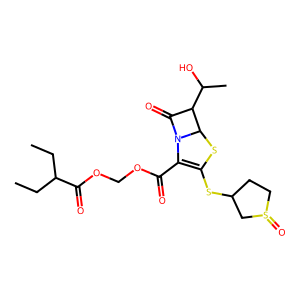
Sulopenem etzadroxil
Names and Identifiers of Sulopenem etzadroxil
CAS Number |
1000296-70-7 |
|---|---|
IUPAC Name |
2-ethylbutanoyloxymethyl (5R,6S)-6-[(1R)-1-hydroxyethyl]-7-oxo-3-[(1R,3S)-1-oxothiolan-3-yl]sulfanyl-4-thia-1-azabicyclo[3.2.0]hept-2-ene-2-carboxylate |
InChI |
InChI=1S/C19H27NO7S3/c1-4-11(5-2)17(23)26-9-27-18(24)14-19(28-12-6-7-30(25)8-12)29-16-13(10(3)21)15(22)20(14)16/h10-13,16,21H,4-9H2,1-3H3/t10-,12+,13+,16-,30-/m1/s1 |
InChIKey |
NBPVNGWRLGHULH-CSOWVJSESA-N |
Canonical SMILES |
CCC(CC)C(=O)OCOC(=O)C1=C(SC2N1C(=O)C2C(C)O)SC3CCS(=O)C3 |
Isomeric SMILES |
CCC(CC)C(=O)OCOC(=O)C1=C(S[C@H]2N1C(=O)[C@@H]2[C@@H](C)O)S[C@H]3CC[S@@](=O)C3 |
UNII |
492M3I304T |
Physical and chemical properties of Sulopenem etzadroxil
Molecular Formula |
C19H27NO7S3 |
|---|---|
Molecular Weight |
477.62 |
Applications of Sulopenem etzadroxil
Sulopenem etzadroxil is primarily being developed for treating complicated urinary tract infections caused by multidrug-resistant organisms. Its oral formulation allows for outpatient treatment options and facilitates transitions from intravenous therapy to oral administration in hospitalized patients. This flexibility is crucial for managing infections effectively while minimizing hospital stays .
Interaction Studies of Sulopenem etzadroxil
Interaction studies indicate that sulopenem etzadroxil can be coadministered with probenecid, which inhibits renal clearance and increases systemic exposure to sulopenem. This combination enhances the drug's effectiveness by prolonging its half-life and ensuring higher concentrations are achieved in urine, which is particularly beneficial for treating urinary tract infections .
Biological Activity of Sulopenem etzadroxil
Sulopenem etzadroxil exhibits potent antibacterial activity against a range of gram-negative bacteria, including strains resistant to multiple drug classes. Its mechanism of action involves binding to penicillin-binding proteins (PBPs), inhibiting bacterial cell wall synthesis, and ultimately leading to cell lysis. Clinical studies have shown that sulopenem is effective against pathogens such as Escherichia coli and Klebsiella pneumoniae, particularly those expressing ESBLs .