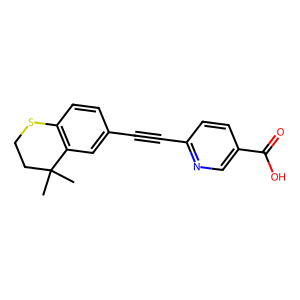
Tazarotenic acid
Names and Identifiers of Tazarotenic acid
CAS Number |
118292-41-4 |
|---|---|
IUPAC Name |
6-[2-(4,4-dimethyl-2,3-dihydrothiochromen-6-yl)ethynyl]pyridine-3-carboxylic acid |
InChI |
InChI=1S/C19H17NO2S/c1-19(2)9-10-23-17-8-4-13(11-16(17)19)3-6-15-7-5-14(12-20-15)18(21)22/h4-5,7-8,11-12H,9-10H2,1-2H3,(H,21,22) |
InChIKey |
IQIBKLWBVJPOQO-UHFFFAOYSA-N |
Canonical SMILES |
CC1(CCSC2=C1C=C(C=C2)C#CC3=NC=C(C=C3)C(=O)O)C |
UNII |
85FDJ14553 |
Physical and chemical properties of Tazarotenic acid
Acidity coefficient |
3.30±0.10(Predicted) |
|---|---|
Boiling Point |
527.5±50.0 °C at 760 mmHg |
Density |
1.3±0.1 g/cm3 |
Exact Mass |
323.097992 |
Flash Point |
272.9±30.1 °C |
Index of Refraction |
1.671 |
LogP |
4.95 |
Melting Point |
>190°C (dec.) |
Molecular Formula |
C19H17NO2S |
Molecular Weight |
323.409 |
PSA |
75.49000 |
Solubility |
DMSO (Slightly, Sonicated), Methanol (Slightly, Sonicated) |
Storage condition |
2-8°C |
Vapour Pressure |
0.0±1.5 mmHg at 25°C |
Applications of Tazarotenic acid
Tazarotenic acid is primarily utilized in dermatological treatments for:
- Plaque Psoriasis: Reduces scaling and inflammation associated with the disease.
- Acne Vulgaris: Normalizes keratinocyte differentiation and reduces comedone formation.
- Photodamaged Skin: Improves skin texture and reduces signs of aging.
It has also shown potential in reducing atypical melanocytes, which are precursors to skin cancer, thereby providing a protective effect against certain skin malignancies.
Interaction Studies of Tazarotenic acid
Studies have demonstrated that tazarotenic acid interacts selectively with retinoic acid receptors (RARα, RARβ, RARγ), influencing gene expression related to skin cell behavior. Its efficacy is enhanced when combined with other treatments (e.g., topical corticosteroids), particularly in psoriasis management. Furthermore, minimal systemic absorption suggests that most effects are localized to the site of application, reducing the risk of systemic side effects.
Biological Activity of Tazarotenic acid
Tazarotenic acid exhibits significant biological activity through its interaction with retinoic acid receptors, particularly RAR-β and RAR-γ. It modulates gene expression related to keratinocyte proliferation and differentiation, leading to therapeutic effects in skin conditions characterized by abnormal keratinocyte behavior. Specifically, it downregulates markers associated with inflammation and keratinocyte hyperproliferation, making it effective in treating psoriasis and acne. Additionally, long-term use has been associated with increased collagen production and improved skin structure.
Physical sample testing spectrum (NMR) of Tazarotenic acid

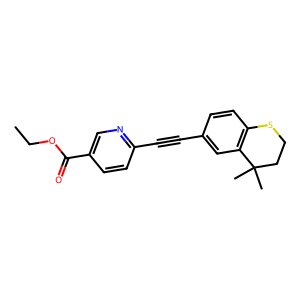 Cas:118292-40-3

 Cas:952294-17-6