
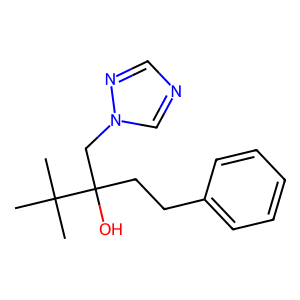
Tebuconazole
CAS No.:
107534-96-3
M. Wt:
307.818
M. Fa:
C16H22ClN3O
InChI Key:
PXMNMQRDXWABCY-UHFFFAOYSA-N
Appearance:
White Solid
Names and Identifiers of Tebuconazole
CAS Number |
107534-96-3 |
|---|---|
EC Number |
403-640-2 |
IUPAC Name |
1-(4-chlorophenyl)-4,4-dimethyl-3-(1,2,4-triazol-1-ylmethyl)pentan-3-ol |
InChI |
InChI=1S/C16H22ClN3O/c1-15(2,3)16(21,10-20-12-18-11-19-20)9-8-13-4-6-14(17)7-5-13/h4-7,11-12,21H,8-10H2,1-3H3 |
InChIKey |
PXMNMQRDXWABCY-UHFFFAOYSA-N |
Canonical SMILES |
CC(C)(C)C(CCC1=CC=C(C=C1)Cl)(CN2C=NC=N2)O |
UNII |
401ATW8TRW |
Physical and chemical properties of Tebuconazole
Acidity coefficient |
13.70±0.29(Predicted) |
|---|---|
Boiling Point |
476.9±55.0 °C at 760 mmHg |
Decomposition |
When heated to decomposition it emits toxic vapors of /hydrogen chloride and nitrogen oxides/. |
Density |
1.1±0.1 g/cm3 |
Exact Mass |
307.145142 |
Flash Point |
242.2±31.5 °C |
Index of Refraction |
1.564 |
LogP |
log Kow = 3.7 |
Melting Point |
105 °C |
Merck |
14,9092 |
Molecular Formula |
C16H22ClN3O |
Molecular Weight |
307.818 |
PSA |
50.94000 |
Stability |
Stable to elevated temperatures, and to photolysis and hydrolysis in pure water, under sterile conditions... . |
Storage condition |
0-6°C |
Vapour Pressure |
1.7X10⁻⁶ Pa (1.3X10⁻⁸ mm Hg) at 20 °C |
Water Solubility |
32 mg/L at 20 ºC |
Routine testing items of Tebuconazole
| Test Item | Common Test Method | Method Overview |
|---|---|---|
| Assay | High-Performance Liquid Chromatography (HPLC) | Uses a reversed-phase C18 column with methanol-water or acetonitrile-water as the mobile phase. Detection is performed using a UV detector (around 220–230 nm), and quantification is achieved by external standard method. Suitable for assay of tebuconazole in technical material and formulations. |
| Assay | Gas Chromatography (GC) | Suitable for volatile samples; after appropriate derivatization, separation is carried out on a capillary column, with detection by ECD or FID. Commonly used for residue analysis or high-purity sample testing. |
| Impurity Analysis | High-Performance Liquid Chromatography-Mass Spectrometry (HPLC-MS) | Combines the separation capability of HPLC with the qualitative power of mass spectrometry to accurately identify and quantify organic impurities and degradation products in tebuconazole. Applicable for related substances testing. |
| Residual Solvents | Gas Chromatography (GC) | Determines residual organic solvents (e.g., methanol, acetone, dichloromethane) from manufacturing processes using headspace sampling-GC, in accordance with the Chinese Pharmacopoeia or ICH guidelines. |
| Crystal Form / Polymorphism Analysis | Differential Scanning Calorimetry (DSC) | Determines melting thermal behavior to distinguish crystal forms of tebuconazole, used for consistency control of active pharmaceutical ingredients. |
| X-Ray Powder Diffraction (XRD) | Provides crystal structure information to identify different polymorphic forms, ensuring physical stability of the product. | |
| Moisture Content | Karl Fischer Titration | Available in volumetric or coulometric methods, this technique precisely measures trace moisture in raw materials, which is particularly important for stability-sensitive formulations. |
| Particle Size Distribution | Laser Particle Size Analysis | Measures particle size distribution of tebuconazole in suspensions or wettable powders, influencing formulation suspension rate and bioavailability. |
| Identification | Infrared Spectroscopy (IR) | Confirms the structure of tebuconazole by comparing sample spectra with reference standards, based on characteristic absorption peaks (e.g., C=N, C-Cl, aromatic ring skeleton vibrations). |
| Related Substances | High-Performance Liquid Chromatography (HPLC) | Uses optimized gradient elution to separate the main component from impurity peaks, detecting degradants or synthesis by-products. Total impurities are typically required to not exceed a specified limit (e.g., 0.5%). |
Safety Information of Tebuconazole


Key Milestone of Tebuconazole
| Year | Event | Notes |
|---|---|---|
| 1977 | First Synthesis | The compound was first synthesized by scientists at Bayer AG in Germany. It belongs to the triazole class of fungicides. |
| 1980s | Bioactivity Screening and Optimization | Bayer AG conducted systematic screening of its fungicidal activity, discovering that it effectively inhibits various fungi (such as powdery mildew, rust, and smut). The molecular structure was optimized to improve selectivity and stability. |
| 1986 | First Commercial Launch | Pentachloronitrobenzene was first marketed under the trade name "Folicur" (Folure) in Germany, used for the control of fungal diseases in grains and fruit trees. |
| 1980s–1990s | Global Promotion and Registration | It received pesticide registration in multiple countries, including the United States, China, and Brazil, and was widely applied to crops such as wheat, corn, rice, grapes, and bananas. |
| 1990s Midterm | Mechanism of Action Clarified | Research confirmed that pentachloronitrobenzene inhibits the biosynthesis of ergosterol in the cell membrane of fungi (as an inhibitor of the CYP51 enzyme), thereby disrupting the cell membrane structure and exerting a fungicidal effect. |
| 2000s | Development of Formulations | It was combined with other fungicides (such as prothiamycin, fludioxonil, etc.) to delay the development of resistance, enhance the spectrum of action, and improve efficacy. |
| 2010s | Environmental and Toxicological Research | Multiple countries conducted assessments of its environmental behavior (soil degradation, water residue) and ecological toxicity (to aquatic organisms, bees, etc.), leading to stricter regulations in some regions. |
| After 2015 | Resistance Management and Alternative Research | With the emergence of resistant strains (such as wheat rust pathogens), research into resistance monitoring and integrated pest management strategies was promoted, and efforts to develop new low-toxicity alternatives were also initiated. |
| Continuing to Present | Wide Application and Regulatory Oversight | Pentachloronitrobenzene remains one of the most widely used triazole fungicides globally, while being subject to stricter risk assessments and usage restrictions in regions such as the EU. |
Biological Activity of Tebuconazole
Tebuconazole exhibits broad-spectrum antifungal properties, making it effective against various pathogens affecting crops, including fungi that cause leaf spots, blights, and rusts. Its mechanism of action primarily involves inhibiting the synthesis of ergosterol, an essential component of fungal cell membranes. This inhibition disrupts cell membrane integrity and function, leading to fungal cell death. Tebuconazole has been shown to be effective against pathogens such as Fusarium, Botrytis, and Sclerotinia species.
Physical sample testing spectrum (NMR) of Tebuconazole

 Cas:97821-63-1
