
Terephthalic acid
CAS No.:
100-21-0
M. Wt:
166.13100
M. Fa:
C8H6O4
InChI Key:
KKEYFWRCBNTPAC-UHFFFAOYSA-N
Appearance:
White Solid
Names and Identifiers of Terephthalic acid
CAS Number |
100-21-0 |
|---|---|
EC Number |
202-830-0 |
MDL Number |
MFCD00002558 |
IUPAC Name |
terephthalic acid |
InChI |
InChI=1S/C8H6O4/c9-7(10)5-1-2-6(4-3-5)8(11)12/h1-4H,(H,9,10)(H,11,12) |
InChIKey |
KKEYFWRCBNTPAC-UHFFFAOYSA-N |
Canonical SMILES |
C1=CC(=CC=C1C(=O)O)C(=O)O |
UNII |
6S7NKZ40BQ |
UNSPSC Code |
12352100 |
Physical and chemical properties of Terephthalic acid
Acidity coefficient |
3.51(at 25℃) |
|---|---|
Boiling Point |
>572 °F (sublimes) |
BRN |
1909333 |
Decomposition |
When heated to decomposition it emits acrid smoke and irritating fumes. |
Density |
1.51 |
Exact Mass |
166.02700 |
Exposure Limits |
ACGIH: TWA 10 mg/m3 |
Flash Point |
260 °C |
Index of Refraction |
1.648 |
LogP |
1.96 |
Melting Point |
sublimes |
Merck |
14,9162 |
Molecular Formula |
C8H6O4 |
Molecular Weight |
166.13100 |
pH |
3.36(1 mM solution);2.79(10 mM solution);2.26(100 mM solution) |
PSA |
74.60000 |
Solubility |
Solubility in water, g/100ml at 20 °C: 0.28 |
Stability |
Stable. Combustible. Incompatible with strong oxidizing agents. |
Storage condition |
0-6°C |
Vapour Pressure |
Vapor pressure, Pa at 20 °C: |
Water Solubility |
slightly soluble in water (0,017 g/L at 25°C) |
Solubility of Terephthalic acid
| Solvent Name | Dissolution Behavior | Effect of Temperature | Effect of pH |
|---|---|---|---|
| Water | Slightly soluble | Dissolution slightly increases with rising temperature | Dissolution significantly increases under alkaline conditions |
| Ethanol | Slightly soluble | Dissolution slightly improves with increasing temperature | Minimal pH effect |
| Acetone | Nearly insoluble | Temperature increase has little effect | Minimal effect from pH changes |
| Acetic acid | Soluble | Dissolves readily at room temperature | Acidic conditions favor dissolution |
| Benzene | Insoluble | No significant change with temperature | pH not applicable |
| Toluene | Insoluble | Insoluble; no significant change with heating | pH not applicable |
| N,N-Dimethylformamide (DMF) | Soluble | Soluble at room temperature; dissolution accelerates with heating | Minor effect from pH changes |
| Sodium hydroxide solution | Highly soluble (forms sodium terephthalate salt) | Dissolution rate increases with rising temperature | High pH significantly enhances solubility |
| Concentrated sulfuric acid | Soluble (may involve chemical reaction) | Soluble at room temperature; exothermic reaction | Soluble under strongly acidic conditions; may form derivatives |
Safety Information of Terephthalic acid

Key Milestone of Terephthalic acid
| Year | Event | Description |
|---|---|---|
| 1846 | First Synthesis | French chemist Amédée Cailliot synthesized terephthalic acid by oxidizing p-xylene, although its structure was not clearly defined at the time. |
| 1850s | Structure Confirmation | German chemists Wilhelm Rudolph Fittig and Adolf von Baeyer, among others, further studied aromatic dicarboxylic acids and confirmed the chemical structure of terephthalic acid (1,4-benzenedicarboxylic acid). |
| 1928 | Preliminary Exploration of Polyester | Wallace Carothers (DuPont) used terephthalic acid with ethylene glycol to synthesize early samples of polyethylene terephthalate (PET), but commercialization was hindered due to purity and process issues. |
| 1941 | PATENT APPLICATION FOR PET | British chemists John Rex Whinfield and James Tennant Dickson (Calico Printers' Association) successfully synthesized high-molecular-weight PET and filed a patent, laying the foundation for PET fiber (polyester). |
| 1945–1950s | Industrial Production Bottleneck | Terephthalic acid was difficult to purify (containing impurities such as 4-carboxybenzaldehyde), limiting large-scale PET production; early methods used dimethyl terephthalate (DMT) instead. |
| Mid-1950s | Breakthrough in PTA Purification Technology | Amoco Corporation (now BP) developed a liquid-phase air oxidation process of para-xylene using a cobalt-manganese-bromine catalyst system combined with hydrogenation purification technology, enabling the production of high-purity PTA. |
| 1959 | Industrialization of Direct Esterification Method for PTA | Amoco implemented a process where PTA directly reacts with ethylene glycol to produce PET, replacing the DMT route, reducing costs, and simplifying the process. |
| 1960–1970s | Global Expansion of PET Industry | PTA became the main raw material for PET production, widely used in synthetic fibers (polyester), plastic bottles, films, and other applications, driving rapid development of the polyester industry. |
| 1980s to present | Green Processes and Increased Capacity | Development of more environmentally friendly catalysts (such as bromine-free systems), energy-saving oxidation processes, and large-scale production expansion globally (especially in Asia), with China becoming the world's largest producer of PTA. |
| 21st Century | Circular Economy and Recycling | PET recycling and regeneration technologies have matured, promoting the reuse of terephthalic acid within closed-loop recycling systems and supporting sustainable development. |
Physical sample testing spectrum (NMR) of Terephthalic acid

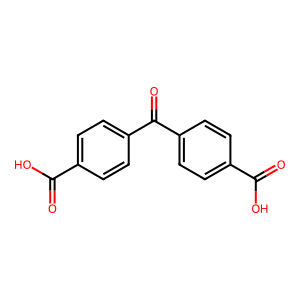 Cas:964-68-1

 Cas:56-23-5

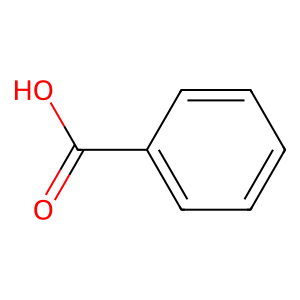 Cas:65-85-0