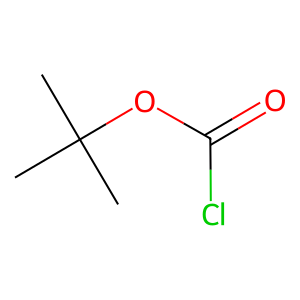
Tert-butyl Chloroformate
CAS No.:
24608-52-4
M. Wt:
136.577
M. Fa:
C5H9ClO2
InChI Key:
UJJDEOLXODWCGK-UHFFFAOYSA-N
Names and Identifiers of Tert-butyl Chloroformate
CAS Number |
24608-52-4 |
|---|---|
IUPAC Name |
tert-butyl carbonochloridate |
InChI |
InChI=1S/C5H9ClO2/c1-5(2,3)8-4(6)7/h1-3H3 |
InChIKey |
UJJDEOLXODWCGK-UHFFFAOYSA-N |
Canonical SMILES |
CC(C)(C)OC(=O)Cl |
Physical and chemical properties of Tert-butyl Chloroformate
Boiling Point |
127.0±9.0 °C at 760 mmHg |
|---|---|
Density |
1.1±0.1 g/cm3 |
Exact Mass |
136.029114 |
Flash Point |
32.9±11.8 °C |
Index of Refraction |
1.419 |
LogP |
2.14 |
Molecular Formula |
C5H9ClO2 |
Molecular Weight |
136.577 |
PSA |
26.30000 |
Vapour Pressure |
11.4±0.2 mmHg at 25°C |
Applications of Tert-butyl Chloroformate
Tert-butyl chloroformate finds diverse applications in organic synthesis:
- Peptide Synthesis: It is widely used for introducing Boc protecting groups in amino acids and peptides.
- Synthesis of Carbamates: Its ability to react with amines makes it useful for synthesizing various carbamate derivatives.
- Preparation of Carbonate Esters: It serves as a precursor for carbonate esters through reactions with alcohols.
Interaction Studies of Tert-butyl Chloroformate
Research into interaction studies primarily focuses on the reactivity of tert-butyl chloroformate with various nucleophiles. The compound's interactions can be influenced by solvent effects, which impact nucleophilicity and electrophilicity during reactions. For instance, studies have shown that solvent polarity can significantly affect reaction rates and mechanisms involving tert-butyl chloroformate.
Similar Compounds: ComparisonTert-butyl chloroformate shares similarities with other chloroformates but exhibits unique characteristics:
| Compound Name | Chemical Formula | Unique Features |
|---|---|---|
| Methyl Chloroformate | C₃H₇ClO₂ | Forms methyl esters; less sterically hindered than tert-butyl. |
| Ethyl Chloroformate | C₄H₉ClO₂ | Forms ethyl esters; similar reactivity but larger size than methyl. |
| Isopropyl Chloroformate | C₄H₉ClO₂ | Forms isopropyl esters; branched structure affects reactivity. |
| Perfluoro-tert-butyl Chloroformate | C₅H₃ClF₅O₂ | Fluorinated variant; exhibits different reactivity patterns due to electronegativity of fluorine. |
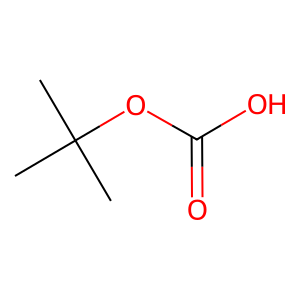 Cas:51300-90-4

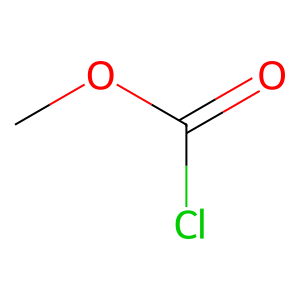 Cas:79-22-1

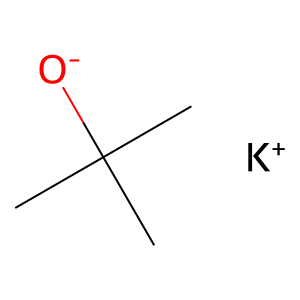 Cas:865-47-4
 Cas:106-97-8
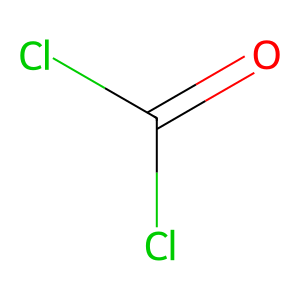 Cas:75-44-5
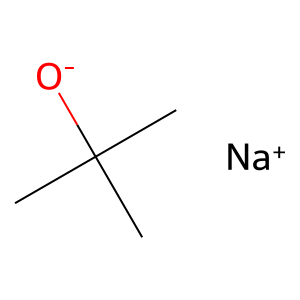 Cas:865-48-5