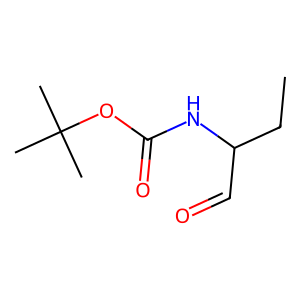
Tert-butyl N-(1-oxobutan-2-yl)carbamate
Names and Identifiers of Tert-butyl N-(1-oxobutan-2-yl)carbamate
CAS Number |
346690-97-9 |
|---|---|
IUPAC Name |
tert-butyl N-(1-oxobutan-2-yl)carbamate |
InChI |
InChI=1S/C9H17NO3/c1-5-7(6-11)10-8(12)13-9(2,3)4/h6-7H,5H2,1-4H3,(H,10,12) |
InChIKey |
NBDAUFXJXMBQRC-UHFFFAOYSA-N |
Canonical SMILES |
CCC(C=O)NC(=O)OC(C)(C)C |
Physical and chemical properties of Tert-butyl N-(1-oxobutan-2-yl)carbamate
Acidity coefficient |
11.43±0.46(Predicted) |
|---|---|
Boiling Point |
266.5±23.0 °C(Predicted) |
Density |
1.000±0.06 g/cm3(Predicted) |
Exact Mass |
187.12100 |
LogP |
1.69300 |
Molecular Formula |
C9H17NO3 |
Molecular Weight |
187.23600 |
PSA |
58.89000 |
Safety Information of Tert-butyl N-(1-oxobutan-2-yl)carbamate

Applications of Tert-butyl N-(1-oxobutan-2-yl)carbamate
Tert-butyl N-(1-oxobutan-2-yl)carbamate has diverse applications across multiple fields:
- Chemistry: It is used as a building block in organic synthesis and as a protecting group for amines during multi-step synthesis.
- Biology: The compound aids in synthesizing biologically active molecules and serves as a reagent in biochemical assays.
- Medicine: It plays a role in developing pharmaceuticals and drug delivery systems due to its ability to form stable carbamate linkages.
- Industry: The compound is involved in producing specialty chemicals and materials, including agrochemicals.
Interaction Studies of Tert-butyl N-(1-oxobutan-2-yl)carbamate
Studies have shown that tert-butyl N-(1-oxobutan-2-yl)carbamate interacts with various molecular targets, influencing biological pathways. Its carbamate group can undergo hydrolysis, releasing active compounds that interact with enzymes or receptors. This interaction is crucial for understanding its role in medicinal chemistry and drug design.
Biological Activity of Tert-butyl N-(1-oxobutan-2-yl)carbamate
The biological activity of tert-butyl N-(1-oxobutan-2-yl)carbamate has been explored in various contexts. It serves as a building block in the synthesis of biologically active molecules, including pharmaceuticals. Its mechanism of action often involves interactions with specific molecular targets, such as enzymes or receptors, making it valuable in drug design and development. Additionally, it is utilized in biochemical assays to study enzyme-catalyzed reactions and protein modifications.
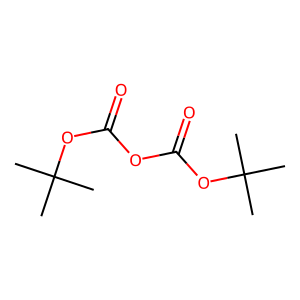 Cas:24424-99-5

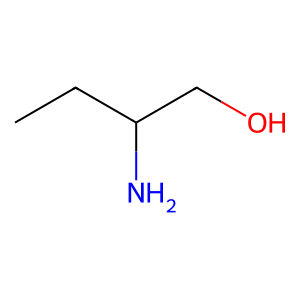 Cas:5856-63-3
