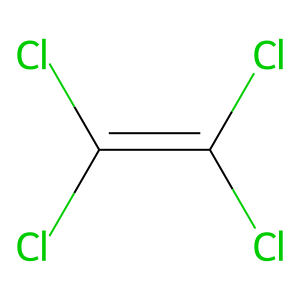
Tetrachloroethylene-13C1
Names and Identifiers of Tetrachloroethylene-13C1
CAS Number |
287399-46-6 |
|---|---|
EC Number |
693-140-2 |
IUPAC Name |
1,1,2,2-tetrachloro(113C)ethene |
InChI |
InChI=1S/C2Cl4/c3-1(4)2(5)6/i1+1 |
InChIKey |
CYTYCFOTNPOANT-OUBTZVSYSA-N |
Canonical SMILES |
C(=C(Cl)Cl)(Cl)Cl |
Isomeric SMILES |
C(=[13C](Cl)Cl)(Cl)Cl |
Physical and chemical properties of Tetrachloroethylene-13C1
Boiling Point |
121ºC(lit.) |
|---|---|
Density |
1.623 g/mL at 25ºC |
Exact Mass |
164.87900 |
LogP |
3.06820 |
Melting Point |
-22ºC(lit.) |
Molecular Formula |
C2Cl4 |
Molecular Weight |
166.82600 |
Safety Information of Tetrachloroethylene-13C1


Applications of Tetrachloroethylene-13C1
Tetrachloroethylene has multiple applications:
- Dry Cleaning: It serves as the primary solvent in dry cleaning processes due to its ability to dissolve oils and grease.
- Degreasing Agent: Used extensively in the automotive and metalworking industries for cleaning metal parts.
- Industrial Solvent: Employed in various chemical processes and as a solvent for organic materials.
- Neutrino Detectors: Its properties make it suitable for use in advanced scientific applications such as neutrino detection.
Interaction Studies of Tetrachloroethylene-13C1
Research on the interactions of tetrachloroethylene with biological systems has shown that it can undergo reductive dechlorination by certain bacteria under anaerobic conditions. Notably, species such as Dehalococcoides spp. can facilitate its breakdown into less harmful compounds like vinyl chloride and ethylene. Under aerobic conditions, co-metabolism by Pseudomonas species has also been observed.
Biological Activity of Tetrachloroethylene-13C1
Tetrachloroethylene has been linked to several adverse health effects. Animal studies indicate that exposure to this compound may lead to liver and kidney damage. Specifically, prolonged inhalation of tetrachloroethylene has been associated with hepatocellular carcinoma in mice. The compound is classified as a confirmed animal carcinogen, and its relevance to human health remains under investigation. Symptoms of exposure include dizziness, headaches, and respiratory issues.
 Cas:78-87-5

 Cas:9003-07-0