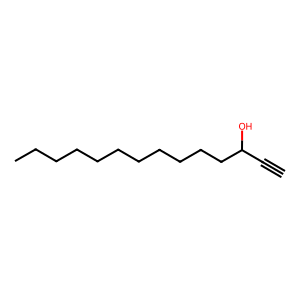
Tetradec-1-yn-3-ol
Names and Identifiers of Tetradec-1-yn-3-ol
CAS Number |
136022-04-3 |
|---|---|
EC Number |
651-864-6 |
MDL Number |
MFCD00185860 |
IUPAC Name |
tetradec-1-yn-3-ol |
InChI |
InChI=1S/C14H26O/c1-3-5-6-7-8-9-10-11-12-13-14(15)4-2/h2,14-15H,3,5-13H2,1H3 |
InChIKey |
XBMBRECRKQFYAT-UHFFFAOYSA-N |
Canonical SMILES |
CCCCCCCCCCCC(C#C)O |
UNSPSC Code |
12352100 |
Physical and chemical properties of Tetradec-1-yn-3-ol
Acidity coefficient |
13.23±0.20(Predicted) |
|---|---|
Boiling Point |
254.7±8.0 °C at 760 mmHg |
Density |
0.9±0.1 g/cm3 |
Exact Mass |
210.198364 |
Flash Point |
110.0±8.2 °C |
Index of Refraction |
1.461 |
LogP |
5.28 |
Molecular Formula |
C14H26O |
Molecular Weight |
210.356 |
Vapour Pressure |
0.0±1.1 mmHg at 25°C |
Safety Information of Tetradec-1-yn-3-ol
Applications of Tetradec-1-yn-3-ol
Tetradec-1-yn-3-ol has various applications in:
- Organic Synthesis: It serves as an intermediate in the synthesis of more complex organic molecules.
- Biological Research: Its biological activity makes it a candidate for studies related to enzyme modulation and receptor interactions.
- Agricultural Chemistry: As a volatile organic compound emitted by biocontrol fungi, it may play a role in pest management strategies.
Interaction Studies of Tetradec-1-yn-3-ol
Research on Tetradec-1-yn-3-ol's interactions focuses on its ability to modulate biological pathways through its functional groups. Studies have shown that the compound can influence enzyme activities and receptor functions, which is critical for understanding its potential therapeutic applications. Specific interaction studies may involve examining its effects on various proteins and enzymes relevant to metabolic pathways.
Biological Activity of Tetradec-1-yn-3-ol
Tetradec-1-yn-3-ol exhibits various biological activities, primarily attributed to its functional groups. The hydroxyl group can engage in hydrogen bonding, which influences interactions with biological molecules. This compound has been studied for its potential effects on enzyme activity and receptor modulation. Its unique structure allows it to participate in addition reactions with nucleophiles, potentially leading to diverse biological effects.