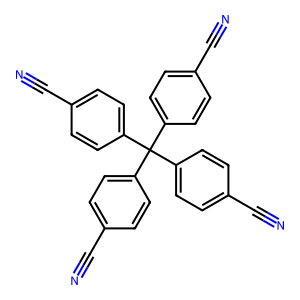
Tetrakis(4-cyanophenyl)methane
CAS No.:
121706-21-6
M. Wt:
420.46400
M. Fa:
C29H16N4
InChI Key:
HXZGMLINTVQVPX-UHFFFAOYSA-N
Appearance:
Pale-yellow Solid
Names and Identifiers of Tetrakis(4-cyanophenyl)methane
CAS Number |
121706-21-6 |
|---|---|
IUPAC Name |
4-[tris(4-cyanophenyl)methyl]benzonitrile |
InChI |
InChI=1S/C29H16N4/c30-17-21-1-9-25(10-2-21)29(26-11-3-22(18-31)4-12-26,27-13-5-23(19-32)6-14-27)28-15-7-24(20-33)8-16-28/h1-16H |
InChIKey |
HXZGMLINTVQVPX-UHFFFAOYSA-N |
Canonical SMILES |
C1=CC(=CC=C1C#N)C(C2=CC=C(C=C2)C#N)(C3=CC=C(C=C3)C#N)C4=CC=C(C=C4)C#N |
Physical and chemical properties of Tetrakis(4-cyanophenyl)methane
Boiling Point |
650.6±55.0 °C(Predicted) |
|---|---|
Density |
1.30±0.1 g/cm3(Predicted) |
Exact Mass |
420.13700 |
LogP |
5.55602 |
Melting Point |
312 °C(Solv: acetonitrile (75-05-8)) |
Molecular Formula |
C29H16N4 |
Molecular Weight |
420.46400 |
PSA |
95.16000 |
Storage condition |
2-8°C |
Applications of Tetrakis(4-cyanophenyl)methane
Tetrakis(4-cyanophenyl)methane has potential applications in various fields:
- Materials Science: Its unique structure lends itself to use in creating advanced materials such as polymers and nanocomposites.
- Organic Electronics: The electronic properties imparted by the cyano groups make it suitable for applications in organic light-emitting diodes and photovoltaic cells.
- Supramolecular Chemistry: It can serve as a building block for supramolecular architectures due to its ability to form host-guest complexes.
Physical sample testing spectrum (NMR) of Tetrakis(4-cyanophenyl)methane

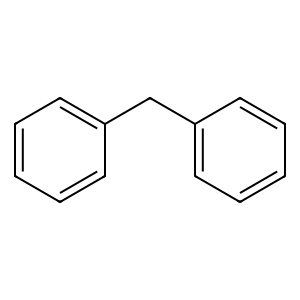 Cas:101-81-5

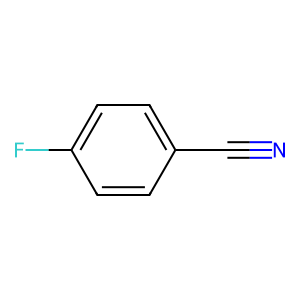 Cas:1194-02-1

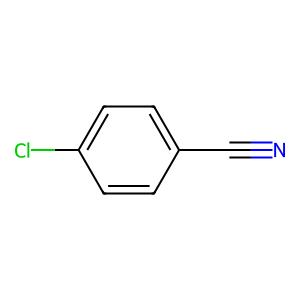 Cas:623-03-0