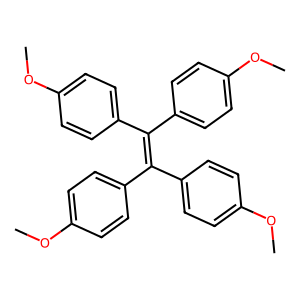
Tetrakis(4-methoxyphenyl)ethylene
Names and Identifiers of Tetrakis(4-methoxyphenyl)ethylene
CAS Number |
10019-24-6 |
|---|---|
IUPAC Name |
1-methoxy-4-[1,2,2-tris(4-methoxyphenyl)ethenyl]benzene |
InChI |
InChI=1S/C30H28O4/c1-31-25-13-5-21(6-14-25)29(22-7-15-26(32-2)16-8-22)30(23-9-17-27(33-3)18-10-23)24-11-19-28(34-4)20-12-24/h5-20H,1-4H3 |
InChIKey |
LXYBRRVOIQFRRL-UHFFFAOYSA-N |
Canonical SMILES |
COC1=CC=C(C=C1)C(=C(C2=CC=C(C=C2)OC)C3=CC=C(C=C3)OC)C4=CC=C(C=C4)OC |
Physical and chemical properties of Tetrakis(4-methoxyphenyl)ethylene
Boiling Point |
574.1ºC at 760 mmHg |
|---|---|
Density |
1.126g/cm3 |
Exact Mass |
452.19900 |
Flash Point |
123.1ºC |
Index of Refraction |
1.594 |
LogP |
6.72840 |
Molecular Formula |
C30H28O4 |
Molecular Weight |
452.54100 |
PSA |
36.92000 |
Vapour Pressure |
1.37E-12mmHg at 25°C |
Applications of Tetrakis(4-methoxyphenyl)ethylene
Tetrakis(4-methoxyphenyl)ethylene has several applications:
- Optoelectronic Devices: Due to its luminescent properties, it is explored for use in organic light-emitting diodes (OLEDs) and other optoelectronic devices.
- Fluorescent Probes: Its ability to switch emission colors makes it a candidate for use as a fluorescent probe in biological imaging.
- Material Science: The compound's unique aggregation behavior can be utilized in the development of advanced materials with tunable optical properties.
Interaction Studies of Tetrakis(4-methoxyphenyl)ethylene
Studies on tetrakis(4-methoxyphenyl)ethylene focus on its interactions with various solvents and matrices. The emission properties can vary significantly based on the solvent environment, indicating potential for tuning optical characteristics through environmental manipulation. Additionally, research into its electron spin resonance properties provides insights into its radical formation and stability under different conditions.
Biological Activity of Tetrakis(4-methoxyphenyl)ethylene
While specific biological activities of tetrakis(4-methoxyphenyl)ethylene are not extensively documented, compounds with similar structures have been investigated for potential applications in drug delivery and as fluorescent probes in biological imaging. The methoxy groups may enhance solubility and bioavailability, suggesting that this compound could have relevant biological interactions worth exploring.
Physical sample testing spectrum (NMR) of Tetrakis(4-methoxyphenyl)ethylene

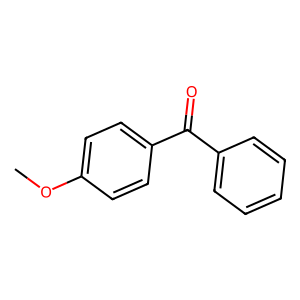 Cas:611-94-9

 Cas:100-66-3