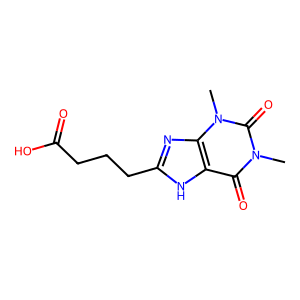
Theophylline-8-butyric acid
CAS No.:
5438-71-1
M. Wt:
266.25300
M. Fa:
C11H14N4O4
InChI Key:
NGBYKZGOXFIONW-UHFFFAOYSA-N
Names and Identifiers of Theophylline-8-butyric acid
CAS Number |
5438-71-1 |
|---|---|
IUPAC Name |
4-(1,3-dimethyl-2,6-dioxo-7H-purin-8-yl)butanoic acid |
InChI |
InChI=1S/C11H14N4O4/c1-14-9-8(10(18)15(2)11(14)19)12-6(13-9)4-3-5-7(16)17/h3-5H2,1-2H3,(H,12,13)(H,16,17) |
InChIKey |
NGBYKZGOXFIONW-UHFFFAOYSA-N |
Canonical SMILES |
CN1C2=C(C(=O)N(C1=O)C)NC(=N2)CCCC(=O)O |
UNII |
1UR2VV86WO |
Physical and chemical properties of Theophylline-8-butyric acid
Boiling Point |
613.3ºC at 760mmHg |
|---|---|
Density |
1.451g/cm3 |
Exact Mass |
266.10200 |
Flash Point |
324.7ºC |
Index of Refraction |
1.609 |
Molecular Formula |
C11H14N4O4 |
Molecular Weight |
266.25300 |
PSA |
109.98000 |
Applications of Theophylline-8-butyric acid
Theophylline-8-butyric acid has potential applications in various fields:
- Pharmaceuticals: It is primarily investigated for use as a bronchodilator in respiratory diseases.
- Research: Its unique properties make it a candidate for studying the mechanisms of action of xanthines and their derivatives in cellular signaling pathways.
- Biotechnology: The compound can be utilized in developing therapeutic agents targeting specific inflammatory pathways .
Interaction Studies of Theophylline-8-butyric acid
Research on the interactions of theophylline-8-butyric acid focuses on its pharmacokinetics and pharmacodynamics:
- Drug Interactions: Studies indicate that this compound may interact with other medications metabolized by cytochrome P450 enzymes, particularly affecting the metabolism of other xanthines and anti-inflammatory drugs .
- Receptor Binding Studies: Investigations into its binding affinity for adenosine receptors reveal insights into its potential therapeutic effects and side effects associated with xanthine derivatives .
Biological Activity of Theophylline-8-butyric acid
Theophylline-8-butyric acid exhibits several biological activities primarily related to its interaction with adenosine receptors and phosphodiesterase enzymes.
- Bronchodilation: Similar to theophylline, it may relax bronchial smooth muscle and improve airflow in conditions like asthma and chronic obstructive pulmonary disease.
- Anti-inflammatory Effects: The compound has been shown to inhibit inflammatory responses by modulating histone deacetylase activity, thus preventing the transcription of pro-inflammatory genes .
- Cyclic Adenosine Monophosphate Modulation: It acts as a phosphodiesterase inhibitor, leading to increased levels of cyclic adenosine monophosphate, which contributes to its bronchodilatory effects .