
Thioanisole
CAS No.:
100-68-5
M. Wt:
124.203
M. Fa:
C7H8S
InChI Key:
HNKJADCVZUBCPG-UHFFFAOYSA-N
Appearance:
Colorless Liquid
Names and Identifiers of Thioanisole
CAS Number |
100-68-5 |
|---|---|
EC Number |
202-878-2 |
MDL Number |
MFCD00008559 |
IUPAC Name |
methylsulfanylbenzene |
InChI |
InChI=1S/C7H8S/c1-8-7-5-3-2-4-6-7/h2-6H,1H3 |
InChIKey |
HNKJADCVZUBCPG-UHFFFAOYSA-N |
Canonical SMILES |
CSC1=CC=CC=C1 |
UNII |
BB4K737YF4 |
UNSPSC Code |
12352100 |
Physical and chemical properties of Thioanisole
Boiling Point |
188.00 to 193.00 °C. @ 760.00 mm Hg |
|---|---|
BRN |
1904179 |
Density |
0.958-0.968 |
Exact Mass |
124.034668 |
Flash Point |
57.2±0.0 °C |
Index of Refraction |
1.532-1.551 |
LogP |
2.74 |
Melting Point |
-15 °C |
Molecular Formula |
C7H8S |
Molecular Weight |
124.203 |
PSA |
25.30000 |
Sensitivity |
Stench |
Solubility |
insoluble in water; soluble in alcohol and oil |
Stability |
Stable. Combustible. Incompatible with strong oxidizing agents. |
Storage condition |
2-8°C |
Vapour Pressure |
0.7±0.3 mmHg at 25°C |
Water Solubility |
INSOLUBLE |
Solubility of Thioanisole
| Solvent | Dissolution Behavior | Temperature Effect | pH Effect |
|---|---|---|---|
| Water | Practically insoluble | No significant effect | No notable effect |
| Ethanol | Soluble | Solubility slightly increases with temperature | Stable under neutral conditions; may decompose under strong acidic or alkaline conditions |
| Diethyl ether | Freely soluble | Increased temperature promotes dissolution | Stable, unaffected by pH |
| Acetone | Freely soluble | Solubility increases with rising temperature | Generally stable; may degrade under extreme pH conditions |
| Chloroform | Freely soluble | Solubility improves with higher temperature | Stable, no obvious pH effect |
| Benzene | Freely soluble | Solubility increases with temperature | No effect |
| Dichloromethane | Freely soluble | Higher temperature enhances solubility | Stable |
| Toluene | Freely soluble | Solubility increases with temperature | No effect |
| Dilute hydrochloric acid | Insoluble or slightly soluble | No noticeable change | May undergo slow hydrolysis under strongly acidic conditions |
| Dilute sodium hydroxide solution | Insoluble | No significant effect | Possible slow decomposition under alkaline conditions |
Safety Information of Thioanisole


Key Milestone of Thioanisole
| Time | Event/Milestone | Description |
|---|---|---|
| Mid-19th Century (c. 1850s–1870s) | Early Research on Organic Sulfur Compound Synthesis | During the early development of organic chemistry, German and French chemists (e.g., Würtz, Hofmann, etc.) systematically studied the synthesis methods of thioether compounds. Methyl phenyl sulfide was likely first synthesized during this period, typically prepared by the reaction of thiophenol with methyl iodide under alkaline conditions. |
| 1880s–1900s | Structure Confirmation and Naming | With the advancement of structural chemistry, the molecular structure of methyl phenyl sulfide (C₆H₅–S–CH₃) was clarified and incorporated into standard textbooks of organic sulfur chemistry as a typical representative of aromatic thioethers. |
| 1930s–1950s | Emergence as an Intermediate in Organic Synthesis | During the development of the pharmaceutical and dye industries, methyl phenyl sulfide was used as a synthetic intermediate, for example, in constructing sulfur-containing heterocycles or as a precursor for protecting groups. |
| 1960s–1970s | Role in Organometallic Chemistry | Methyl phenyl sulfide was found to act as a ligand coordinating with transition metals (e.g., palladium, platinum), used to study the effects of sulfur ligands on catalytic reactions, advancing the field of coordination chemistry. |
| 1980s–1990s | Use as a Model Compound in Mechanistic Studies | In studies on oxidation reactions, C–S bond cleavage, etc., methyl phenyl sulfide was often used as a model substrate to help elucidate mechanisms of biological metabolism (e.g., cytochrome P450-mediated sulfide oxidation) or environmental degradation. |
| 2000s–Present | Expanded Applications in Materials Science and Medicinal Chemistry | Used in the construction of sulfur-containing functional molecules, such as liquid crystal materials and fluorescent probe precursors; also serves as a building block in the development of novel sulfur-containing drugs (e.g., anti-inflammatory, antibacterial compounds). |
| 2010s–Present | Research in Green Synthesis and Sustainable Chemistry | Development of more environmentally friendly synthetic routes (e.g., solvent-free conditions, catalytic C–S coupling reactions) for the preparation of methyl phenyl sulfide, reflecting its value in modern green chemistry for teaching and research. |
Applications of Thioanisole
Thioanisole finds applications across various fields:
- Organic Synthesis: It serves as an important intermediate in the synthesis of pharmaceuticals and agrochemicals.
- Flavoring and Fragrance: Due to its pleasant odor, thioanisole is utilized in the production of flavoring agents and fragrances.
- Chemical Reagent: Thioanisole acts as a reagent in
Interaction Studies of Thioanisole
Interaction studies involving thioanisole have highlighted its reactivity with different chemical species. For example:
- Oxidative Interactions: The interaction of thioanisole with hydrogen peroxide has been extensively studied, revealing its oxidation pathways and the formation of reactive oxygen species under catalysis.
- Electrochemical Behavior: Research has shown that thioanisole's behavior in electrochemical environments can lead to significant insights into its dimerization dynamics and structural properties.
Biological Activity of Thioanisole
Thioanisole exhibits biological activity that has been explored in various contexts. It has been studied for its potential effects on biological systems, including its interactions with enzymes and its role in oxidative stress responses. The oxidation of thioanisole by lignin peroxidase has been documented, indicating its relevance in biocatalytic processes. Moreover, it may affect sensitive amino acids under certain conditions, potentially impacting metabolic pathways.
Physical sample testing spectrum (NMR) of Thioanisole


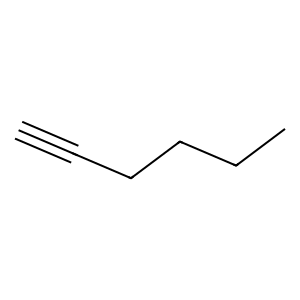 Cas:693-02-7

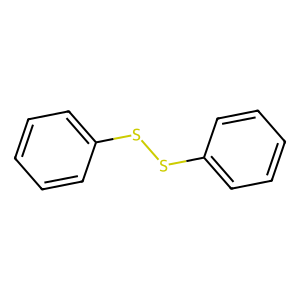 Cas:882-33-7