
Thiophene-2-carbonitrile
Names and Identifiers of Thiophene-2-carbonitrile
CAS Number |
1003-31-2 |
|---|---|
EC Number |
213-706-0 |
MDL Number |
MFCD00005416 |
IUPAC Name |
thiophene-2-carbonitrile |
InChI |
InChI=1S/C5H3NS/c6-4-5-2-1-3-7-5/h1-3H |
InChIKey |
CUPOOAWTRIURFT-UHFFFAOYSA-N |
Canonical SMILES |
C1=CSC(=C1)C#N |
UNSPSC Code |
12352100 |
Physical and chemical properties of Thiophene-2-carbonitrile
Boiling Point |
193.0±13.0 °C at 760 mmHg |
|---|---|
BRN |
107035 |
Density |
1.2±0.1 g/cm3 |
Exact Mass |
108.998619 |
Exposure Limits |
NIOSH: IDLH 25 mg/m3 |
Flash Point |
53.3±0.0 °C |
Index of Refraction |
1.571 |
LogP |
1.27 |
Melting Point |
125-134 °C (decomp) |
Molecular Formula |
C5H3NS |
Molecular Weight |
109.149 |
PSA |
52.03000 |
Storage condition |
Flammables area |
Vapour Pressure |
0.5±0.4 mmHg at 25°C |
Water Solubility |
Slightly miscible with water. |
Safety Information of Thiophene-2-carbonitrile


Applications of Thiophene-2-carbonitrile
2-Thiophenecarbonitrile has diverse applications across multiple fields:
- Organic Synthesis: It serves as an intermediate in the synthesis of various organic compounds, particularly in creating functionalized thiophene derivatives.
- Material Science: The compound is used in developing organic semiconductors and photovoltaic materials due to its electronic properties.
- Pharmaceutical Chemistry: Its derivatives are explored for potential therapeutic applications, including anticancer agents and fluorescent markers for biological imaging.
Interaction Studies of Thiophene-2-carbonitrile
Studies have focused on understanding how 2-thiophenecarbonitrile interacts with biological macromolecules. For instance, research indicates that certain derivatives can interact with protein aggregates, making them useful for studying neurodegenerative diseases like prion diseases. These interactions highlight the compound's potential in biomedical research.
Biological Activity of Thiophene-2-carbonitrile
Research indicates that 2-thiophenecarbonitrile and its derivatives exhibit various biological activities. Some studies have suggested potential applications in medicinal chemistry, particularly regarding their anticancer properties. The compound's structure allows it to interact with biological targets, although specific mechanisms of action require further investigation.
Physical sample testing spectrum (NMR) of Thiophene-2-carbonitrile

 Cas:1003-09-4

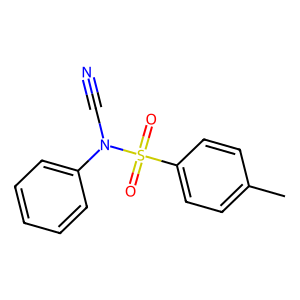 Cas:55305-43-6

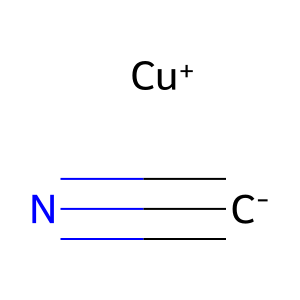 Cas:544-92-3
 Cas:557-19-7