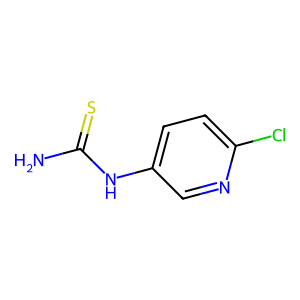
Thiourea, (6-chloro-3-pyridinyl)-
CAS No.:
125117-97-7
M. Wt:
187.65000
M. Fa:
C6H6ClN3S
InChI Key:
KQNRFXLAUHMUSH-UHFFFAOYSA-N
Names and Identifiers of Thiourea, (6-chloro-3-pyridinyl)-
CAS Number |
125117-97-7 |
|---|---|
MDL Number |
MFCD15525455 |
IUPAC Name |
(6-chloropyridin-3-yl)thiourea |
InChI |
InChI=1S/C6H6ClN3S/c7-5-2-1-4(3-9-5)10-6(8)11/h1-3H,(H3,8,10,11) |
InChIKey |
KQNRFXLAUHMUSH-UHFFFAOYSA-N |
Canonical SMILES |
NC(=S)NC1=CC=C(Cl)N=C1 |
UNSPSC Code |
12352100 |
Physical and chemical properties of Thiourea, (6-chloro-3-pyridinyl)-
Exact Mass |
186.99700 |
|---|---|
H Bond Acceptors |
1 |
H Bond Donors |
2 |
LogP |
2.18420 |
Molecular Formula |
C6H6ClN3S |
Molecular Weight |
187.65000 |
PSA |
87.57000 |
Safety Information of Thiourea, (6-chloro-3-pyridinyl)-

Applications of Thiourea, (6-chloro-3-pyridinyl)-
Of Thiourea Derivatives: Detailed Review" class="citation ml-xs inline" data-state="closed" href="https://www.mdpi.com/2624-8549/6/3/25" rel="nofollow noopener" target="_blank"> .Material science: Thiourea derivatives are utilized in the synthesis of polymers and other materials due to their unique chemical properties.
Interaction Studies of Thiourea, (6-chloro-3-pyridinyl)-
Studies on (6-Chloropyridin-3-yl)thiourea interactions focus on:
- Binding affinity with proteins: Research has shown that this compound can interact with specific enzymes and receptors, influencing their activity.
- Complex formation with metals: Its ability to form stable complexes with transition metals has been investigated for potential catalytic applications.
Biological Activity of Thiourea, (6-chloro-3-pyridinyl)-
This compound exhibits significant biological activities, including:
- Antimicrobial properties: Studies have shown that (6-Chloropyridin-3-yl)thiourea demonstrates inhibitory effects against various bacterial strains, including Staphylococcus aureus and Escherichia coli .
- Antitumor activity: It has been evaluated for its potential as an antitumor agent, with some derivatives showing promising results against solid tumors.
- Anti-inflammatory effects: Certain derivatives of thiourea compounds have been noted for their ability to inhibit pro-inflammatory cytokines, suggesting potential therapeutic applications in inflammatory diseases