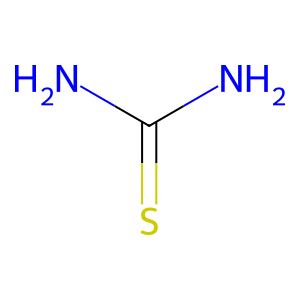
Thiourea-15N2
CAS No.:
287476-21-5
M. Wt:
78.10770
M. Fa:
CH4N2S
InChI Key:
UMGDCJDMYOKAJW-SUEIGJEOSA-N
Names and Identifiers of Thiourea-15N2
CAS Number |
287476-21-5 |
|---|---|
EC Number |
685-261-4 |
IUPAC Name |
bis(15N)(azanyl)methanethione |
InChI |
InChI=1S/CH4N2S/c2-1(3)4/h(H4,2,3,4)/i2+1,3+1 |
InChIKey |
UMGDCJDMYOKAJW-SUEIGJEOSA-N |
Canonical SMILES |
C(=S)(N)N |
Isomeric SMILES |
C(=S)([15NH2])[15NH2] |
Physical and chemical properties of Thiourea-15N2
Density |
1.326g/cm3 |
|---|---|
Exact Mass |
78.00360 |
Index of Refraction |
1.654 |
LogP |
0.58930 |
Melting Point |
170-176ºC(lit.) |
Molecular Formula |
CH4N2S |
Molecular Weight |
78.10770 |
PSA |
84.13000 |
Safety Information of Thiourea-15N2


Applications of Thiourea-15N2
Thiourea-15N2 has diverse applications across various fields:
- Organic Synthesis: Used as a reagent and catalyst in the synthesis of organic compounds.
- Biological Research: Employed for isotopic labeling to trace nitrogen metabolism.
- Pharmaceutical Development: Investigated for its potential use in developing anticancer and antibacterial drugs.
- Industrial Uses: Utilized in producing photographic films, dyes, elastomers, plastics, and textiles.
Interaction Studies of Thiourea-15N2
Studies involving thiourea derivatives have demonstrated their interactions with biological systems and catalysts. For instance, thiourea acts as a promoter in electrochemical nitrogen reduction reactions on nickel sulfide catalysts. Understanding these interactions helps elucidate the mechanisms by which thiourea compounds influence biochemical pathways and catalytic processes.
Biological Activity of Thiourea-15N2
Thiourea-15N2 exhibits several biological activities that make it a subject of interest in medicinal chemistry. It has been investigated for its potential therapeutic properties, including:
- Anticancer Activity: Research has indicated that thiourea derivatives can inhibit cancer cell growth through various mechanisms.
- Antibacterial Activity: Thiourea-based compounds have shown effectiveness against certain bacterial strains, making them candidates for antibiotic development.
- Isotopic Labeling: The nitrogen-15 isotope allows researchers to trace nitrogen pathways in biological systems, enhancing our understanding of metabolic processes.
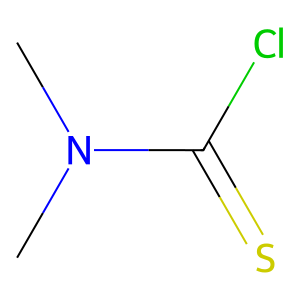 Cas:16420-13-6

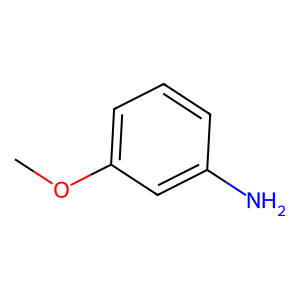 Cas:536-90-3

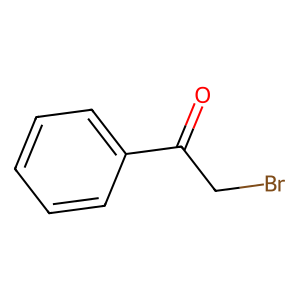 Cas:70-11-1