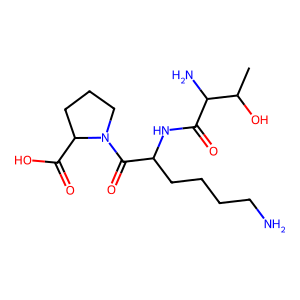
Threonyl-lysyl-proline
Names and Identifiers of Threonyl-lysyl-proline
CAS Number |
41961-56-2 |
|---|---|
IUPAC Name |
(2S)-1-[(2S)-6-amino-2-[[(2S,3R)-2-amino-3-hydroxybutanoyl]amino]hexanoyl]pyrrolidine-2-carboxylic acid |
InChI |
InChI=1S/C15H28N4O5/c1-9(20)12(17)13(21)18-10(5-2-3-7-16)14(22)19-8-4-6-11(19)15(23)24/h9-12,20H,2-8,16-17H2,1H3,(H,18,21)(H,23,24)/t9-,10+,11+,12+/m1/s1 |
InChIKey |
WFAUDCSNCWJJAA-RHYQMDGZSA-N |
Canonical SMILES |
CC(C(C(=O)NC(CCCCN)C(=O)N1CCCC1C(=O)O)N)O |
Isomeric SMILES |
C[C@H]([C@@H](C(=O)N[C@@H](CCCCN)C(=O)N1CCC[C@H]1C(=O)O)N)O |
Physical and chemical properties of Threonyl-lysyl-proline
Boiling Point |
707.4ºC at 760mmHg |
|---|---|
Density |
1.288g/cm3 |
Exact Mass |
344.20600 |
Flash Point |
381.6ºC |
Index of Refraction |
1.56 |
LogP |
0.11330 |
Molecular Formula |
C15H28N4O5 |
Molecular Weight |
344.40700 |
PSA |
158.98000 |
Applications of Threonyl-lysyl-proline
Threonyl-lysyl-proline has potential applications in various fields:
- Pharmaceuticals: Due to its inhibitory properties, it may serve as a lead compound for drug development targeting specific enzymes.
- Biotechnology: It can be used in protein engineering and modification processes.
- Nutraceuticals: Its amino acid composition may contribute to dietary supplements aimed at enhancing health and wellness.
Interaction Studies of Threonyl-lysyl-proline
Interaction studies involving threonyl-lysyl-proline focus on its binding affinity with enzymes and receptors. The compound's ability to modulate enzymatic activity suggests interactions with:
- Enzymes: Particularly those involved in metabolic pathways where lysine plays a crucial role.
- Receptors: Potential binding sites could include those associated with neurotransmission or hormonal regulation.
Understanding these interactions is essential for elucidating the compound's biological roles and therapeutic potential.
Biological Activity of Threonyl-lysyl-proline
Threonyl-lysyl-proline exhibits significant biological activity, particularly in relation to its inhibitory effects on certain enzymatic processes. Research indicates that this compound can inhibit specific enzymatic functions at low concentrations, with an inhibitory power of approximately 60% at concentrations ranging from 200 nanograms to 20 picograms . This suggests potential applications in therapeutic contexts where modulation of enzymatic activity is desired.
Additionally, the unique combination of threonine, lysine, and proline may contribute to its role in protein synthesis and cellular signaling pathways.