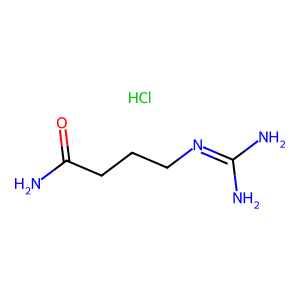
Tiformin hydrochloride
Names and Identifiers of Tiformin hydrochloride
CAS Number |
23256-39-5 |
|---|---|
EC Number |
607-214-9 |
IUPAC Name |
4-(diaminomethylideneamino)butanamide;hydrochloride |
InChI |
InChI=1S/C5H12N4O.ClH/c6-4(10)2-1-3-9-5(7)8;/h1-3H2,(H2,6,10)(H4,7,8,9);1H |
InChIKey |
QHQKFKHTHUDEQS-UHFFFAOYSA-N |
Canonical SMILES |
C(CC(=O)N)CN=C(N)N.Cl |
UNII |
6T8E9HET7P |
Physical and chemical properties of Tiformin hydrochloride
Boiling Point |
424.4ºC at 760mmHg |
|---|---|
Exact Mass |
180.07800 |
Flash Point |
210.5ºC |
LogP |
1.87760 |
Molecular Formula |
C5H13ClN4O |
Molecular Weight |
180.63600 |
PSA |
105.98000 |
Vapour Pressure |
2.08E-07mmHg at 25°C |
Applications of Tiformin hydrochloride
Tiformin hydrochloride has several applications, primarily in the medical field:
- Antidiabetic Agent: Similar to metformin, Tiformin is investigated for its potential use in managing type 2 diabetes by improving insulin sensitivity and reducing hepatic glucose production.
- Metabolic Disorders: It may be beneficial in treating conditions related to metabolic syndrome due to its effects on lipid metabolism and inflammation.
- Research Tool: Tiformin is also used in laboratory settings to study metabolic pathways and drug interactions.
Interaction Studies of Tiformin hydrochloride
Studies on Tiformin hydrochloride have focused on its interactions with various biological systems:
- Drug Interactions: Research indicates that Tiformin may interact with other antidiabetic medications, potentially enhancing or diminishing their effects. Understanding these interactions is crucial for developing combination therapies.
- Biochemical Pathways: Interaction studies have demonstrated that Tiformin influences key metabolic pathways, including those involving insulin signaling and glucose transport mechanisms.
These interactions underscore the importance of careful monitoring when using Tiformin in therapeutic contexts.
Biological Activity of Tiformin hydrochloride
Tiformin hydrochloride exhibits significant biological activity, particularly in the modulation of metabolic processes. Research indicates that it may influence glucose metabolism and insulin sensitivity, similar to other biguanides like metformin. Its mechanism of action is thought to involve the activation of AMP-activated protein kinase (AMPK), which plays a crucial role in cellular energy homeostasis and glucose uptake.
Additionally, Tiformin has shown potential anti-inflammatory effects, which could be beneficial in managing conditions associated with chronic inflammation.