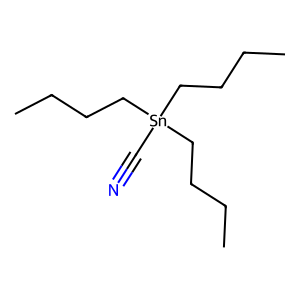
Tributylstannanecarbonitrile
Names and Identifiers of Tributylstannanecarbonitrile
CAS Number |
2179-92-2 |
|---|---|
EC Number |
627-847-4 |
IUPAC Name |
tributylstannylformonitrile |
InChI |
InChI=1S/3C4H9.CN.Sn/c3*1-3-4-2;1-2;/h3*1,3-4H2,2H3;; |
InChIKey |
GMYAQHAKWKXYHG-UHFFFAOYSA-N |
Canonical SMILES |
CCCC[Sn](CCCC)(CCCC)C#N |
Physical and chemical properties of Tributylstannanecarbonitrile
Appearance of Characters |
solid |
|---|---|
Boiling Point |
300.1ºC at 760mmHg |
Exact Mass |
317.11700 |
Flash Point |
135.3ºC |
LogP |
4.89828 |
Melting Point |
105-107ºC(lit.) |
Molecular Formula |
C13H27NSn |
Molecular Weight |
316.06100 |
PSA |
23.79000 |
Safety Information of Tributylstannanecarbonitrile

Applications of Tributylstannanecarbonitrile
Tributylstannanecarbonitrile finds applications across various fields:
- Organic Synthesis: It serves as an important reagent for synthesizing nitriles and other organic compounds.
- Biochemical Research: Its interactions with biological molecules make it useful for studying enzyme mechanisms and protein functions.
- Environmental Studies: Due to its organotin nature, it is also examined for its environmental impact and potential toxicity.
The compound's unique properties enable diverse applications that span both synthetic chemistry and biological research.
Interaction Studies of Tributylstannanecarbonitrile
Interaction studies involving tributylstannanecarbonitrile focus on its biochemical effects. Research has shown that it can interact with various enzymes and proteins, influencing their activity and stability. These studies are crucial for understanding the compound's potential toxicity and its implications for human health and environmental safety.
The compound's interactions often lead to significant biological effects, necessitating further investigation into its mechanisms of action and long-term impacts on living organisms.
Biological Activity of Tributylstannanecarbonitrile
Tributylstannanecarbonitrile exhibits notable biological activity, particularly in its interactions with enzymes and proteins. It has been reported to have toxic effects due to the release of toxic gases upon contact with acids. The compound's organotin nature suggests potential endocrine-disrupting properties, which have raised concerns regarding its environmental and health impacts.
Research indicates that tributylstannanecarbonitrile can affect cellular processes and has been studied for its potential implications in biochemical pathways. Its toxicity profile necessitates careful handling and consideration in both laboratory and industrial settings.
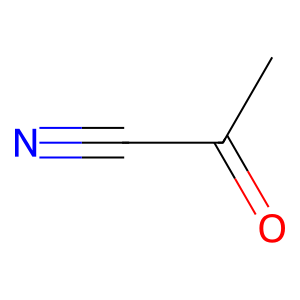 Cas:631-57-2

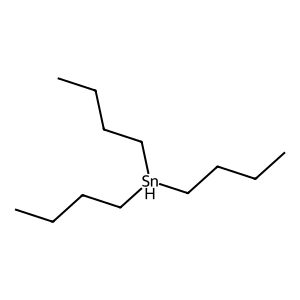 Cas:688-73-3

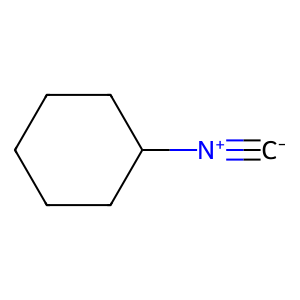 Cas:931-53-3