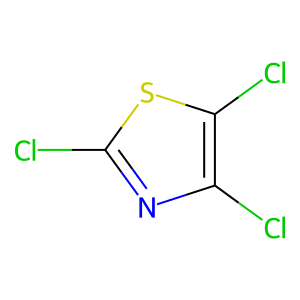
Trichlorothiazole
Names and Identifiers of Trichlorothiazole
CAS Number |
50844-30-9 |
|---|---|
EC Number |
256-794-6 |
MDL Number |
MFCD21086227 |
IUPAC Name |
2,4,5-trichloro-1,3-thiazole |
InChI |
InChI=1S/C3Cl3NS/c4-1-2(5)8-3(6)7-1 |
InChIKey |
FDWSIACICRBLGW-UHFFFAOYSA-N |
Canonical SMILES |
C1(=C(SC(=N1)Cl)Cl)Cl |
UNSPSC Code |
12352100 |
Physical and chemical properties of Trichlorothiazole
Boiling Point |
270ºC at 760mmHg |
|---|---|
Density |
1.745g/cm3 |
Exact Mass |
186.88200 |
Flash Point |
117.1ºC |
H Bond Acceptors |
1 |
H Bond Donors |
0 |
Index of Refraction |
1.609 |
LogP |
3.10330 |
Molecular Formula |
C3Cl3NS |
Molecular Weight |
188.46300 |
PSA |
41.13000 |
Storage condition |
2-8°C |
Safety Information of Trichlorothiazole

Applications of Trichlorothiazole
Trichlorothiazole finds applications across various domains:
- Agriculture: Used as a fungicide and bactericide to protect crops from fungal diseases.
- Pharmaceuticals: Investigated for its potential anti-cancer properties and as an antimicrobial agent.
- Chemical Intermediates: Serves as a precursor in the synthesis of other complex organic compounds.
Its unique structure allows it to participate in diverse
Interaction Studies of Trichlorothiazole
Interaction studies of trichlorothiazole have focused on its behavior in biological systems and its interactions with various enzymes and receptors. Research indicates that it can inhibit certain cytochrome P450 enzymes, which are crucial for drug metabolism. This inhibition could lead to drug-drug interactions when used alongside other pharmaceuticals.
Furthermore, studies have explored its binding affinity to various biological targets, providing insights into its mechanism of action as an antimicrobial agent.
Biological Activity of Trichlorothiazole
Trichlorothiazole exhibits notable biological activity, particularly as a fungicide and bactericide. Its mechanism of action is often linked to the inhibition of key enzymatic processes in microbial cells. Studies have shown that it can disrupt cellular functions, making it effective against various pathogens. Moreover, it has been investigated for potential use in cancer therapy due to its ability to induce apoptosis in certain cancer cell lines.