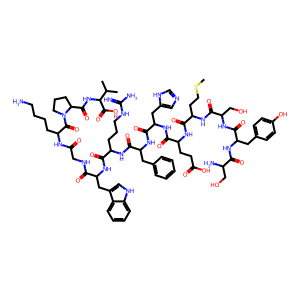
Tridecactide
CAS No.:
22006-64-0
M. Wt:
1623.83000
M. Fa:
C75H106N20O19S
InChI Key:
VGBVAARMQYYITG-DESRROFGSA-N
Names and Identifiers of Tridecactide
CAS Number |
22006-64-0 |
|---|---|
IUPAC Name |
(4S)-5-[[(2S)-1-[[(2S)-1-[[(2S)-1-[[(2S)-1-[[2-[[(2S)-6-amino-1-[(2S)-2-[[(1S)-1-carboxy-2-methylpropyl]carbamoyl]pyrrolidin-1-yl]-1-oxohexan-2-yl]amino]-2-oxoethyl]amino]-3-(1H-indol-3-yl)-1-oxopropan-2-yl]amino]-5-carbamimidamido-1-oxopentan-2-yl]amino]-1-oxo-3-phenylpropan-2-yl]amino]-3-(1H-imidazol-5-yl)-1-oxopropan-2-yl]amino]-4-[[(2S)-2-[[(2S)-2-[[(2S)-2-[[(2S)-2-amino-3-hydroxypropanoyl]amino]-3-(4-hydroxyphenyl)propanoyl]amino]-3-hydroxypropanoyl]amino]-4-methylsulfanylbutanoyl]amino]-5-oxopentanoic acid |
InChI |
InChI=1S/C75H106N20O19S/c1-41(2)62(74(113)114)94-72(111)59-19-12-29-95(59)73(112)53(17-9-10-27-76)85-60(99)37-83-64(103)56(33-44-35-82-49-16-8-7-15-47(44)49)91-65(104)50(18-11-28-81-75(78)79)86-68(107)55(31-42-13-5-4-6-14-42)90-70(109)57(34-45-36-80-40-84-45)92-66(105)51(24-25-61(100)101)87-67(106)52(26-30-115-3)88-71(110)58(39-97)93-69(108)54(89-63(102)48(77)38-96)32-43-20-22-46(98)23-21-43/h4-8,13-16,20-23,35-36,40-41,48,50-59,62,82,96-98H,9-12,17-19,24-34,37-39,76-77H2,1-3H3,(H,80,84)(H,83,103)(H,85,99)(H,86,107)(H,87,106)(H,88,110)(H,89,102)(H,90,109)(H,91,104)(H,92,105)(H,93,108)(H,94,111)(H,100,101)(H,113,114)(H4,78,79,81)/t48-,50-,51-,52-,53-,54-,55-,56-,57-,58-,59-,62-/m0/s1 |
InChIKey |
VGBVAARMQYYITG-DESRROFGSA-N |
Canonical SMILES |
CC(C)C(C(=O)O)NC(=O)C1CCCN1C(=O)C(CCCCN)NC(=O)CNC(=O)C(CC2=CNC3=CC=CC=C32)NC(=O)C(CCCNC(=N)N)NC(=O)C(CC4=CC=CC=C4)NC(=O)C(CC5=CN=CN5)NC(=O)C(CCC(=O)O)NC(=O)C(CCSC)NC(=O)C(CO)NC(=O)C(CC6=CC=C(C=C6)O)NC(=O)C(CO)N |
Isomeric SMILES |
CC(C)[C@@H](C(=O)O)NC(=O)[C@@H]1CCCN1C(=O)[C@H](CCCCN)NC(=O)CNC(=O)[C@H](CC2=CNC3=CC=CC=C32)NC(=O)[C@H](CCCNC(=N)N)NC(=O)[C@H](CC4=CC=CC=C4)NC(=O)[C@H](CC5=CN=CN5)NC(=O)[C@H](CCC(=O)O)NC(=O)[C@H](CCSC)NC(=O)[C@H](CO)NC(=O)[C@H](CC6=CC=C(C=C6)O)NC(=O)[C@H](CO)N |
Physical and chemical properties of Tridecactide
Density |
1.49g/cm3 |
|---|---|
Exact Mass |
1622.77000 |
Index of Refraction |
1.684 |
LogP |
2.71440 |
Molecular Formula |
C75H106N20O19S |
Molecular Weight |
1623.83000 |
PSA |
659.41000 |
Storage condition |
2-8℃ |
Applications of Tridecactide
Tridecactide has several potential applications:
- Therapeutics for Viral Infections: It is being studied as a treatment option for COVID-19 due to its immunomodulatory effects.
- Autoimmune Disease Management: Its ability to influence immune responses makes it a candidate for treating autoimmune diseases like multiple sclerosis.
- Research Tool: Tridecactide can be used in research settings to study melanocortin receptor functions and their roles in various physiological processes.
Interaction Studies of Tridecactide
Studies on Tridecactide's interactions reveal:
- Receptor Binding Studies: Research indicates that Tridecactide binds effectively to melanocortin receptors, which play crucial roles in regulating immune responses and inflammation.
- Combination Therapies: Investigations into its use alongside other drugs highlight potential synergistic effects in treating complex diseases such as multiple sclerosis.
Biological Activity of Tridecactide
Tridecactide has shown promising biological activities:
- Immunomodulation: It has been investigated for its ability to modulate immune responses, particularly in conditions like multiple sclerosis.
- Antiviral Properties: Research indicates that Tridecactide may have therapeutic potential against viral infections, including COVID-19, by enhancing immune response mechanisms.
- Receptor Agonism: It interacts with melanocortin receptors, triggering various downstream signaling pathways that can influence cellular responses such as inflammation and metabolism.