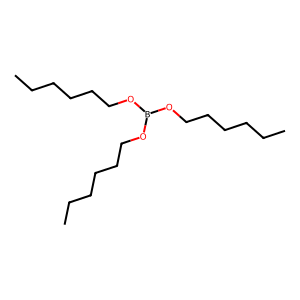
Trihexyl borate
CAS No.:
5337-36-0
M. Wt:
314.311
M. Fa:
C18H39BO3
InChI Key:
KDQYHGMMZKMQAA-UHFFFAOYSA-N
Appearance:
Colorless to Almost colorless clear liquid
Names and Identifiers of Trihexyl borate
CAS Number |
5337-36-0 |
|---|---|
EC Number |
226-262-8 |
IUPAC Name |
trihexyl borate |
InChI |
InChI=1S/C18H39BO3/c1-4-7-10-13-16-20-19(21-17-14-11-8-5-2)22-18-15-12-9-6-3/h4-18H2,1-3H3 |
InChIKey |
KDQYHGMMZKMQAA-UHFFFAOYSA-N |
Canonical SMILES |
B(OCCCCCC)(OCCCCCC)OCCCCCC |
UNII |
9LK29O7A4Y |
Physical and chemical properties of Trihexyl borate
Boiling Point |
315.6±10.0 °C at 760 mmHg |
|---|---|
Density |
0.9±0.1 g/cm3 |
Exact Mass |
314.299225 |
Flash Point |
125.8±21.7 °C |
Index of Refraction |
1.427 |
LogP |
9.42 |
Molecular Formula |
C18H39BO3 |
Molecular Weight |
314.311 |
PSA |
27.69000 |
Vapour Pressure |
0.0±0.6 mmHg at 25°C |
Safety Information of Trihexyl borate

Applications of Trihexyl borate
Trihexyl borate finds applications in various fields:
- Organic Synthesis: It serves as a reagent for producing boronic acids.
- Plasticizer: Used in the formulation of plastics to enhance flexibility.
- Lubricants: Acts as an additive in lubricating oils due to its stability and low volatility.
- Chemical Intermediate: Functions as a precursor for other organoboron compounds .
Interaction Studies of Trihexyl borate
Studies on the interactions involving trihexyl borate have primarily focused on its complexation behavior with metal ions and other organic substrates. It has been shown to form stable complexes, which can be utilized in catalysis and material science applications. For instance, interaction with phosphonium salts has been explored for potential applications in ionic liquids .
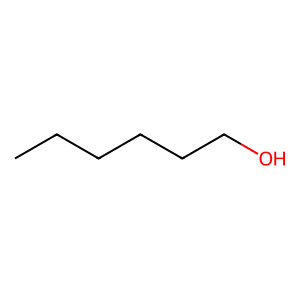 Cas:111-27-3
