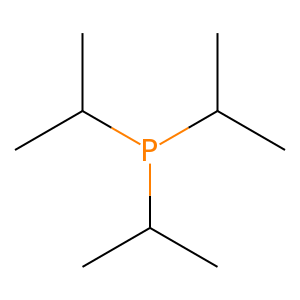
Triisopropylphosphine
CAS No.:
6476-36-4
M. Wt:
160.23700
M. Fa:
C9H21P
InChI Key:
IGNTWNVBGLNYDV-UHFFFAOYSA-N
Appearance:
Solid
Names and Identifiers of Triisopropylphosphine
CAS Number |
6476-36-4 |
|---|---|
EC Number |
229-333-1 |
IUPAC Name |
tri(propan-2-yl)phosphane |
InChI |
InChI=1S/C9H21P/c1-7(2)10(8(3)4)9(5)6/h7-9H,1-6H3 |
InChIKey |
IGNTWNVBGLNYDV-UHFFFAOYSA-N |
Canonical SMILES |
CC(C)P(C(C)C)C(C)C |
UNII |
MDE86CLL2B |
Physical and chemical properties of Triisopropylphosphine
Boiling Point |
81 °C22 mm Hg(lit.) |
|---|---|
Density |
0.839 g/mL at 25 °C(lit.) |
Exact Mass |
160.13800 |
Flash Point |
1 °F |
Index of Refraction |
n20/D 1.466(lit.) |
LogP |
3.69350 |
Molecular Formula |
C9H21P |
Molecular Weight |
160.23700 |
PSA |
13.59000 |
Storage condition |
Flammables area |
Safety Information of Triisopropylphosphine


Applications of Triisopropylphosphine
Triisopropylphosphine has diverse applications in organic synthesis and catalysis:
- Catalyst in Organic Reactions: It serves as a ligand in various catalytic transformations, including hydrogenation and cross-coupling reactions.
- Reducing Agent: Its ability to donate electrons makes it useful as a reducing agent in organic synthesis.
- Ligand for Metal Complexes: Triisopropylphosphine is often employed as a ligand in coordination chemistry to stabilize metal complexes.
Interaction Studies of Triisopropylphosphine
Interaction studies involving triisopropylphosphine focus on its role as a ligand in metal complexes. Research indicates that its steric bulk and electronic properties influence the reactivity and stability of these complexes. For example, its interaction with ruthenium has been studied extensively, revealing insights into catalytic mechanisms and product formation.
 Cas:75-26-3

 Cas:20491-53-6

 Cas:75-30-9
 Cas:920-39-8