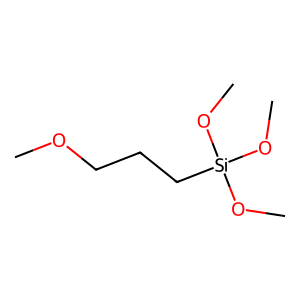
Trimethoxy(3-methoxypropyl)silane
CAS No.:
33580-59-5
M. Wt:
194.301
M. Fa:
C7H18O4Si
InChI Key:
JPMBLOQPQSYOMC-UHFFFAOYSA-N
Appearance:
Colorless Liquid
Names and Identifiers of Trimethoxy(3-methoxypropyl)silane
CAS Number |
33580-59-5 |
|---|---|
MDL Number |
MFCD00054721 |
IUPAC Name |
trimethoxy(3-methoxypropyl)silane |
InChI |
InChI=1S/C7H18O4Si/c1-8-6-5-7-12(9-2,10-3)11-4/h5-7H2,1-4H3 |
InChIKey |
JPMBLOQPQSYOMC-UHFFFAOYSA-N |
Canonical SMILES |
COCCC[Si](OC)(OC)OC |
UNSPSC Code |
12352100 |
Physical and chemical properties of Trimethoxy(3-methoxypropyl)silane
Boiling Point |
168.1±23.0 °C at 760 mmHg |
|---|---|
Density |
0.9±0.1 g/cm3 |
Exact Mass |
194.097443 |
Flash Point |
41.8±23.0 °C |
Index of Refraction |
1.404 |
LogP |
0.36 |
Melting Point |
<0ºC |
Molecular Formula |
C7H18O4Si |
Molecular Weight |
194.301 |
PSA |
36.92000 |
Storage condition |
2~8℃,Seal |
Vapour Pressure |
2.2±0.3 mmHg at 25°C |
Safety Information of Trimethoxy(3-methoxypropyl)silane

Applications of Trimethoxy(3-methoxypropyl)silane
Trimethoxy(3-methoxypropyl)silane finds utility across various industries:
- Adhesives and Sealants: It acts as a coupling agent that improves adhesion between inorganic substrates (like glass or metals) and organic polymers.
- Coatings: Used in surface treatments to enhance water repellency and durability.
- Composite Materials: Enhances the mechanical properties of composites by promoting better bonding between fillers and resin matrices.
- Biomedical
Interaction Studies of Trimethoxy(3-methoxypropyl)silane
Studies on trimethoxy(3-methoxypropyl)silane often focus on its interactions with different substrates. It has been shown to significantly improve adhesion properties when applied to glass fibers or metal surfaces. The compound's ability to form strong covalent bonds with hydroxylated surfaces makes it particularly effective in reinforcing composite materials. Furthermore, research indicates that its hydrolysis products can react with various functional groups present on organic polymers, enhancing compatibility and performance.
Physical sample testing spectrum (NMR) of Trimethoxy(3-methoxypropyl)silane

 Cas:2530-87-2
