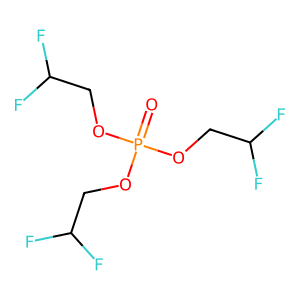
Tris(2,2-difluoroethyl)phosphate
CAS No.:
358-64-5
M. Wt:
290.09700
M. Fa:
C6H9F6O4P
InChI Key:
BWKQKTMHHAZKLV-UHFFFAOYSA-N
Names and Identifiers of Tris(2,2-difluoroethyl)phosphate
CAS Number |
358-64-5 |
|---|---|
IUPAC Name |
tris(2,2-difluoroethyl) phosphate |
InChI |
InChI=1S/C6H9F6O4P/c7-4(8)1-14-17(13,15-2-5(9)10)16-3-6(11)12/h4-6H,1-3H2 |
InChIKey |
BWKQKTMHHAZKLV-UHFFFAOYSA-N |
Canonical SMILES |
C(C(F)F)OP(=O)(OCC(F)F)OCC(F)F |
Physical and chemical properties of Tris(2,2-difluoroethyl)phosphate
Boiling Point |
253-255℃ |
|---|---|
Density |
1.417±0.06 g/cm3(Predicted) |
Exact Mass |
290.01400 |
LogP |
2.93960 |
Molecular Formula |
C6H9F6O4P |
Molecular Weight |
290.09700 |
PSA |
54.57000 |
Applications of Tris(2,2-difluoroethyl)phosphate
Tris(2,2-difluoroethyl)phosphate is primarily used as:
- Flame Retardant: Its main application lies in the textile industry where it enhances fire resistance in fabrics.
- Plasticizer: It is also employed in various polymer formulations to improve flexibility and durability.
- Chemical Intermediate: Due to its reactive phosphate group, it serves as an intermediate in the synthesis of other chemical compounds.
Interaction Studies of Tris(2,2-difluoroethyl)phosphate
Interaction studies involving tris(2,2-difluoroethyl)phosphate have focused on its behavior in biological systems and its effects on various organisms. Research indicates that while it has low acute toxicity, chronic exposure may lead to bioaccumulation and potential endocrine disruption. Studies have also explored its interactions with enzymes involved in metabolic processes, revealing insights into its environmental fate and potential impacts on ecosystems.
 Cas:359-13-7

 Cas:7726-95-6
