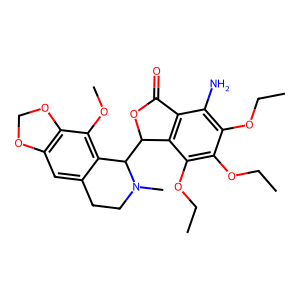
Tritoqualine
Names and Identifiers of Tritoqualine
CAS Number |
14504-73-5 |
|---|---|
EC Number |
858-360-7 |
IUPAC Name |
7-amino-4,5,6-triethoxy-3-(4-methoxy-6-methyl-7,8-dihydro-5H-[1,3]dioxolo[4,5-g]isoquinolin-5-yl)-3H-2-benzofuran-1-one |
InChI |
InChI=1S/C26H32N2O8/c1-6-31-23-17-16(18(27)24(32-7-2)25(23)33-8-3)26(29)36-21(17)19-15-13(9-10-28(19)4)11-14-20(22(15)30-5)35-12-34-14/h11,19,21H,6-10,12,27H2,1-5H3 |
InChIKey |
IRGJVQIJENCTQF-UHFFFAOYSA-N |
Canonical SMILES |
CCOC1=C(C(=C(C2=C1C(OC2=O)C3C4=C(C5=C(C=C4CCN3C)OCO5)OC)N)OCC)OCC |
UNII |
F4MW5166YH |
Physical and chemical properties of Tritoqualine
Acidity coefficient |
6.22±0.40(Predicted) |
|---|---|
Boiling Point |
647.2ºC at 760mmHg |
Density |
1.296g/cm3 |
Exact Mass |
500.21600 |
Flash Point |
345.2ºC |
Index of Refraction |
1.595 |
LogP |
4.16200 |
Melting Point |
183° |
Molecular Formula |
C26H32N2O8 |
Molecular Weight |
500.54100 |
PSA |
110.94000 |
Storage condition |
2-8℃ |
Vapour Pressure |
1.22E-16mmHg at 25°C |
Applications of Tritoqualine
Tritoqualine is primarily used in clinical settings for the treatment of allergic conditions such as:
- Urticaria: Reducing hives and itching.
- Allergic Rhinitis: Alleviating symptoms such as sneezing and nasal congestion.
Its unique action mechanism makes it suitable for patients who experience adverse effects from conventional antihistamines. Additionally, research into its potential applications in other therapeutic areas continues, given its inhibitory effects on histamine production.
Interaction Studies of Tritoqualine
Tritoqualine has been studied for its interactions with various drugs and biological systems. Notably, it may enhance the anticholinergic effects of other medications such as Hyoscyamine. Furthermore, interactions with imaging agents like Iofetamine I-123 have been observed, indicating that Tritoqualine may influence sedative activities. Understanding these interactions is crucial for optimizing therapeutic regimens and minimizing adverse effects in clinical practice.
Biological Activity of Tritoqualine
Tritoqualine exhibits notable biological activity as an antihistamine. Its inhibition of histidine decarboxylase leads to reduced histamine release, thus alleviating symptoms associated with allergic reactions. Studies have indicated that Tritoqualine does not have significant sedative effects, making it a favorable option for patients who require antihistamines without drowsiness. Furthermore, its unique mechanism allows it to be effective in managing conditions like urticaria and allergic rhinitis with minimal side effects.