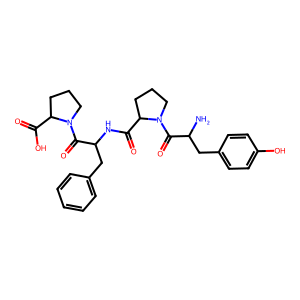
Tyrosyl-prolyl-phenylalanyl-proline
Names and Identifiers of Tyrosyl-prolyl-phenylalanyl-proline
CAS Number |
74171-19-0 |
|---|---|
IUPAC Name |
(2S)-1-[(2S)-2-[[(2S)-1-[(2S)-2-amino-3-(4-hydroxyphenyl)propanoyl]pyrrolidine-2-carbonyl]amino]-3-phenylpropanoyl]pyrrolidine-2-carboxylic acid |
InChI |
InChI=1S/C28H34N4O6/c29-21(16-19-10-12-20(33)13-11-19)26(35)31-14-4-8-23(31)25(34)30-22(17-18-6-2-1-3-7-18)27(36)32-15-5-9-24(32)28(37)38/h1-3,6-7,10-13,21-24,33H,4-5,8-9,14-17,29H2,(H,30,34)(H,37,38)/t21-,22-,23-,24-/m0/s1 |
InChIKey |
DCGNJQAPLOBXDM-ZJZGAYNASA-N |
Canonical SMILES |
C1CC(N(C1)C(=O)C(CC2=CC=C(C=C2)O)N)C(=O)NC(CC3=CC=CC=C3)C(=O)N4CCCC4C(=O)O |
Isomeric SMILES |
C1C[C@H](N(C1)C(=O)[C@H](CC2=CC=C(C=C2)O)N)C(=O)N[C@@H](CC3=CC=CC=C3)C(=O)N4CCC[C@H]4C(=O)O |
Physical and chemical properties of Tyrosyl-prolyl-phenylalanyl-proline
Boiling Point |
895.3ºC at 760 mmHg |
|---|---|
Density |
1.351g/cm3 |
Exact Mass |
522.24800 |
Flash Point |
495.2ºC |
Index of Refraction |
1.633 |
LogP |
2.02310 |
Molecular Formula |
C28H34N4O6 |
Molecular Weight |
522.59300 |
PSA |
153.27000 |
Storage condition |
-15°C |
Applications of Tyrosyl-prolyl-phenylalanyl-proline
Tyrosyl-prolyl-phenylalanyl-proline has potential applications in various fields:
- Pharmaceuticals: Due to its opioid-like effects, it may be explored for therapeutic uses in pain management.
- Nutraceuticals: As a bioactive peptide, it may be included in dietary supplements aimed at improving metabolic health.
- Research: It serves as a model compound for studying peptide interactions and protein folding mechanisms due to its unique structural properties.
Interaction Studies of Tyrosyl-prolyl-phenylalanyl-proline
Research into the interactions of tyrosyl-prolyl-phenylalanyl-proline has revealed its ability to coordinate with metal ions, which is significant for understanding its role in bioinorganic chemistry. Studies have shown that peptides containing proline and aromatic residues can form complexes with metal ions, providing insights into their biological functions and potential applications in metal ion transport systems within cells.
Biological Activity of Tyrosyl-prolyl-phenylalanyl-proline
Tyrosyl-prolyl-phenylalanyl-proline has been identified as a bioactive peptide, particularly recognized as beta-casomorphin 4, which is derived from the digestion of milk protein casein. This peptide exhibits opioid-like activity by binding to opioid receptors present in various tissues, including the gut and brain. Its action influences several physiological processes, including fat intake regulation and postprandial metabolism.
The peptide's interaction with opioid receptors triggers a cascade of biochemical pathways that can modulate metabolic functions and potentially contribute to pain management and appetite regulation.