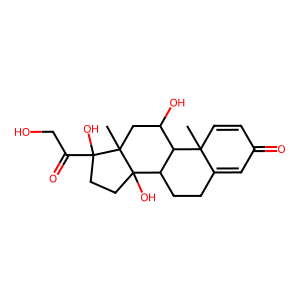
Unii-MT32xmb69T
Names and Identifiers of Unii-MT32xmb69T
CAS Number |
95815-58-0 |
|---|---|
IUPAC Name |
(8R,9S,10R,11S,13S,14R,17R)-11,14,17-trihydroxy-17-(2-hydroxyacetyl)-10,13-dimethyl-6,7,8,9,11,12,15,16-octahydrocyclopenta[a]phenanthren-3-one |
InChI |
InChI=1S/C21H28O6/c1-18-6-5-13(23)9-12(18)3-4-14-17(18)15(24)10-19(2)20(14,26)7-8-21(19,27)16(25)11-22/h5-6,9,14-15,17,22,24,26-27H,3-4,7-8,10-11H2,1-2H3/t14-,15+,17-,18+,19+,20-,21+/m1/s1 |
InChIKey |
USJJKJYVBSEDNP-CNPAUTQISA-N |
Canonical SMILES |
CC12CC(C3C(C1(CCC2(C(=O)CO)O)O)CCC4=CC(=O)C=CC34C)O |
Isomeric SMILES |
C[C@]12C[C@@H]([C@H]3[C@H]([C@@]1(CC[C@@]2(C(=O)CO)O)O)CCC4=CC(=O)C=C[C@]34C)O |
UNII |
MT32XMB69T |
Physical and chemical properties of Unii-MT32xmb69T
Exact Mass |
376.18900 |
|---|---|
LogP |
0.67250 |
Molecular Formula |
C21H28O6 |
Molecular Weight |
376.44300 |
PSA |
115.06000 |
Applications of Unii-MT32xmb69T
Unii-MT32xmb69T has several applications in medicinal chemistry and pharmacology:
- Pharmaceutical Development: Used as a lead compound for designing new anti-inflammatory drugs.
- Hormonal Therapies: Investigated for potential use in therapies targeting hormonal imbalances.
- Research Tool: Employed in studies exploring steroid receptor interactions and their effects on cellular processes.
The versatility of this compound makes it valuable in both research and therapeutic contexts.
Interaction Studies of Unii-MT32xmb69T
Studies involving Unii-MT32xmb69T have focused on its interactions with various biological targets:
- Steroid Receptors: Binding affinity studies have shown its capability to interact with glucocorticoid receptors, influencing gene expression related to inflammation and metabolism.
- Enzyme Inhibition: Research suggests that it may inhibit enzymes involved in steroid metabolism, which can affect the bioavailability of other steroids in the system.
These interaction studies are crucial for understanding the compound's mechanism of action and therapeutic potential.
Biological Activity of Unii-MT32xmb69T
Unii-MT32xmb69T exhibits significant biological activity due to its steroidal structure. It has been studied for its potential as an anti-inflammatory agent and for its role in modulating hormonal activities. The compound's ability to bind to steroid receptors may influence various physiological processes, including:
- Anti-inflammatory effects: By inhibiting pro-inflammatory cytokines.
- Hormonal regulation: Acting as a modulator of steroid hormones involved in metabolism and immune responses.
Research indicates that compounds with similar structures often exhibit varying degrees of biological activity based on their specific functional groups and stereochemistry.