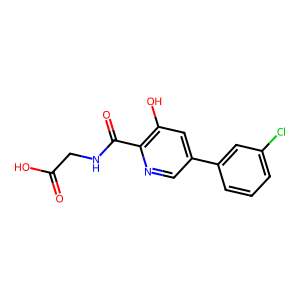
Vadadustat
Names and Identifiers of Vadadustat
CAS Number |
1000025-07-9 |
|---|---|
EC Number |
815-079-4 |
MDL Number |
MFCD30470233 |
IUPAC Name |
2-[[5-(3-chlorophenyl)-3-hydroxypyridine-2-carbonyl]amino]acetic acid |
InChI |
InChI=1S/C14H11ClN2O4/c15-10-3-1-2-8(4-10)9-5-11(18)13(16-6-9)14(21)17-7-12(19)20/h1-6,18H,7H2,(H,17,21)(H,19,20) |
InChIKey |
JGRXMPYUTJLTKT-UHFFFAOYSA-N |
Canonical SMILES |
C1=CC(=CC(=C1)Cl)C2=CC(=C(N=C2)C(=O)NCC(=O)O)O |
UNII |
I60W9520VV |
UNSPSC Code |
12352100 |
Physical and chemical properties of Vadadustat
Acidity coefficient |
4.09±0.40(Predicted) |
|---|---|
Boiling Point |
674.6±55.0 °C(Predicted) |
Density |
1.461±0.06 g/cm3(Predicted) |
Exact Mass |
306.04100 |
H Bond Acceptors |
5 |
H Bond Donors |
3 |
LogP |
2.31290 |
Melting Point |
172-174°C |
Molecular Formula |
C14H11ClN2O4 |
Molecular Weight |
306.70100 |
PSA |
99.52000 |
Solubility |
DMSO (Slightly), Methanol (Slightly) |
Stability |
Hygroscopic |
Storage condition |
2-8℃ |
Safety Information of Vadadustat


Applications of Vadadustat
The primary application of vadadustat is in the treatment of anemia associated with chronic kidney disease. Its ability to stimulate endogenous erythropoietin production makes it a promising alternative to traditional erythropoiesis-stimulating agents, which have been linked to serious cardiovascular complications when overused. Additionally, ongoing research is exploring its potential anti-inflammatory properties and other therapeutic applications beyond anemia management.
Interaction Studies of Vadadustat
Vadadustat has been evaluated for potential interactions with various substances commonly used in conjunction with anemia treatment. Studies indicate that iron supplements and phosphate binders may influence its pharmacokinetics; thus, it is recommended to administer vadadustat at specific intervals relative to these agents to optimize efficacy and minimize adverse effects. Furthermore, monitoring for interactions with statins and other medications is advised due to potential overlaps in metabolic pathways.
Biological Activity of Vadadustat
The biological activity of vadadustat is centered around its ability to enhance erythropoietin production without stimulating vascular endothelial growth factor secretion, which can lead to unwanted side effects such as increased risk of thrombosis. Research indicates that vadadustat increases erythropoietin release from liver cells in a dose-dependent manner, demonstrating its potential efficacy in correcting anemia. Additionally, it has been shown to have minimal interaction with cytochrome P450 enzymes, suggesting a lower risk of drug-drug interactions compared to other treatments.
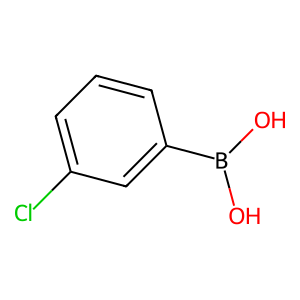 Cas:63503-60-6
