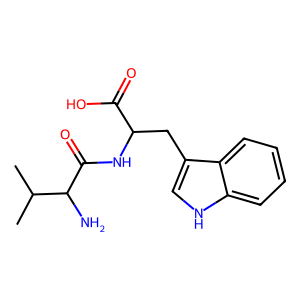
Val-trp
Names and Identifiers of Val-trp
CAS Number |
24587-37-9 |
|---|---|
IUPAC Name |
(2S)-2-[[(2S)-2-amino-3-methylbutanoyl]amino]-3-(1H-indol-3-yl)propanoic acid |
InChI |
InChI=1S/C16H21N3O3/c1-9(2)14(17)15(20)19-13(16(21)22)7-10-8-18-12-6-4-3-5-11(10)12/h3-6,8-9,13-14,18H,7,17H2,1-2H3,(H,19,20)(H,21,22)/t13-,14-/m0/s1 |
InChIKey |
LZDNBBYBDGBADK-KBPBESRZSA-N |
Canonical SMILES |
CC(C)C(C(=O)NC(CC1=CNC2=CC=CC=C21)C(=O)O)N |
Isomeric SMILES |
CC(C)[C@@H](C(=O)N[C@@H](CC1=CNC2=CC=CC=C21)C(=O)O)N |
UNII |
3G64B4AFQN |
Physical and chemical properties of Val-trp
Acidity coefficient |
3.14±0.10(Predicted) |
|---|---|
Boiling Point |
604.8±55.0 °C at 760 mmHg |
Density |
1.3±0.1 g/cm3 |
Exact Mass |
303.158295 |
Flash Point |
319.6±31.5 °C |
Index of Refraction |
1.624 |
LogP |
-0.74 |
Molecular Formula |
C16H21N3O3 |
Molecular Weight |
303.356 |
PSA |
108.21000 |
Storage condition |
−20°C |
Vapour Pressure |
0.0±1.8 mmHg at 25°C |
Solubility of Val-trp
| Solvent | Dissolution Phenomenon | Temperature Effect | pH Effect |
|---|---|---|---|
| Water | Soluble, forms a clear solution | Solubility increases slightly with temperature | Most stable in neutral to weakly alkaline conditions (pH 6–8) |
| Ethanol | Slightly soluble, partially dissolves, may become turbid | Increased temperature improves solubility | Solubility decreases under acidic conditions |
| Methanol | Soluble, solution is clear | Heating promotes dissolution | Better solubility under weakly acidic or neutral conditions |
| Acetone | Insoluble, precipitation or undissolved material present | Temperature has limited effect on solubility | No significant effect observed |
| Acetonitrile | Good solubility, clear and transparent solution | Solubility improves with increasing temperature | Performs best under neutral conditions |
| DMSO | Highly soluble, forms a homogeneous solution | Temperature has little effect; dissolves completely at room temperature | Tolerates a wide pH range, but may degrade under strong acidic or alkaline conditions |
| Chloroform | Nearly insoluble, phase separation is evident | No significant effect | No significant effect |
| DMF | Easily soluble, clear solution | Heating accelerates dissolution | Alkaline conditions are more favorable for dissolution |
Key Milestone of Val-trp
| Time | Event | Description |
|---|---|---|
| 1990s – early 2000s | Research on peptide penetration in the skin and lymphatic circulation emerges | Scientists began exploring the potential of small-molecule peptides in transdermal absorption and promoting lymphatic drainage, laying the foundation for the later discovery of Dipeptide-2. |
| 2002 | Dipeptide-2 was first disclosed in a patent (Patent No.: WO2002058653A1) | Applied for by Sederma (now part of Croda International), it was first publicly disclosed as Dipeptide-2 (Val-Trp) as an active ingredient with the ability to promote lymphatic circulation around the eyes, reduce under-eye bags and swelling. |
| 2003 – 2005 | Verification of in vitro and in vivo efficacy | Studies showed that Dipeptide-2 could enhance microcirculation and lymphatic drainage of the skin, reduce fluid accumulation around the eyes, thus improving the appearance of under-eye bags and dark circles. |
| 2006 | First commercial application in high-end skincare products | Sederma introduced it under the trade name "Eyeliss™" to the market, as an active ingredient for reducing under-eye bags and firming the eye area, widely used in eye cream formulations. |
| 2010s | It became a mainstream ingredient for eye care | Dipeptide-2 was adopted by multiple international skincare brands (such as La Prairie, Estée Lauder, Olay, etc.) and became one of the common peptide ingredients in anti-aging and eye care products. |
| After 2015 | Increasing trend of combination with other active peptides | It is often combined with other peptides such as Acetyl Hexapeptide-8 (Argireline®) and Palmitoyl Pentapeptide-4 to form a multi-functional peptide system that provides anti-wrinkle, firming, and de-swelling effects. |
| Since 2020s | Ongoing research and expansion of applications | Although the core mechanism still focuses on lymphatic drainage, further research has explored its potential synergistic effects in improving microcirculation, antioxidant properties, and supporting the skin barrier. It is widely used in eye care products in Asian markets such as South Korea and Japan. |
Applications of Val-trp
Val-Trp has several applications across different fields:
- Nutritional Supplements: It is explored for its potential benefits in enhancing mood and cognitive function due to tryptophan's role as a precursor to serotonin.
- Pharmaceuticals: Investigated for its therapeutic potential in treating mood disorders and other neurological conditions.
- Research: Used in studies focusing on peptide interactions, stability, and structure-function relationships in biological systems.
Interaction Studies of Val-trp
Research into Val-Trp's interactions has highlighted its ability to form hydrogen bonds and engage in hydrophobic interactions within biological membranes. Studies utilizing molecular mechanics and density functional theory have shown that the spatial arrangement of Val-Trp significantly affects its interaction with other biomolecules. These interactions are crucial for understanding its biological activity and potential therapeutic applications.
Biological Activity of Val-trp
Val-Trp has been studied for its potential biological activities, including antioxidant properties and roles in cellular signaling pathways. The presence of tryptophan allows for interactions with serotonin receptors, suggesting implications in mood regulation and neurochemical signaling. Furthermore, Val-Trp's structural characteristics may influence its bioavailability and efficacy as a dietary supplement or therapeutic agent.
Physical sample testing spectrum (NMR) of Val-trp

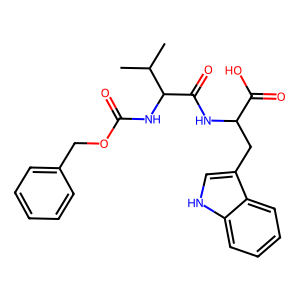 Cas:18904-53-5

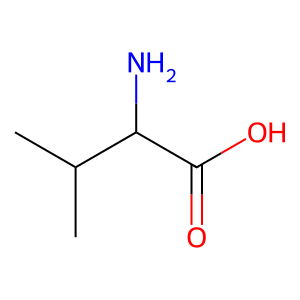 Cas:72-18-4

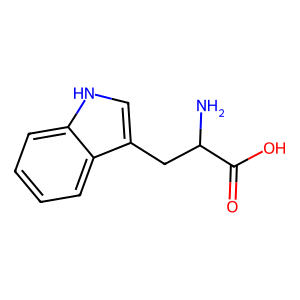 Cas:73-22-3